
Membership, Processes, and Indemnity Provision Policy
Membership Framework
Membership Management
Who Can Become A Member?
Membership of UMAPs is open to individuals who meet the eligibility requirements, as set out below. Eligibility criteria, rights, and benefits may vary depending on the category of membership applied for. Applicants for membership must ensure that they meet the specific eligibility requirements for the membership category they are seeking.
The following individuals are eligible for membership, subject to them satisfying the criteria applicable to the relevant membership category:
- Qualified Physician Associates
Individuals who have successfully completed a recognised Physician Associate qualification – and are not actively studying or working for another medical profession - Qualified Anaesthesia Associates
Individuals who have successfully completed a recognised Anaesthesia Associate qualification – and are not actively studying or working for another medical profession - Physician Associate /Anaesthesia Associate Students
Individuals currently undertaking a recognised course of study leading to qualification as a Medical Associate Professional (Physician Associate and Anaesthesia Associate programmes). - Temporarily Non-Practising or Non-Employed Members
Qualified Physician Associates and Anaesthesia Associates who are temporarily not- practicing as a Physician Associate/ Anaesthesia Associate due to redundancy, illness, caring responsibilities, a career break, or an inability to secure suitable employment. - Invited or Associate Members
Individuals who do not fall within the categories above but who support the aims and objectives of UMAPs and who have been invited to apply for membership by an existing member, subject to approval and any additional conditions set by UMAPs National Executive Committee (NEC).
UMAPs reserves the right to: request evidence of eligibility to determine the appropriate membership category and to amend or withdraw any membership category at any time.
Exclusions
No person shall be eligible for membership if any of the following apply:
- Previous Expulsion
The individual has previously been expelled from UMAPs or from the College of Medical Associate Professionals (CMAPs) . - Removal or Barring from the GMC Register
The individual has been struck off, barred from joining or otherwise unable to be on the General Medical Council Register, except where the individual is actively contesting the decision with the assistance and support of UMAPs.
The determination of eligibility under this section shall rest with the NEC and such determinations shall be final.
How Do I Become A Member?
An individual may apply to become a member of UMAPs by completing the online membership application form available on the UMAPs website.
Applicants must select the appropriate category of membership and provide accurate, complete, and up-to-date information.
UMAPs reserves the right to: require verification of identity, professional status, student status, or any other relevant information to confirm eligibility.
Member Categories
Membership categories are defined in the Trade Union Rule Book to confer the rights of members that qualify for membership within each category. All membership products (i.e. the memberships you see on the website when purchasing your membership) will fall into a category that underpins the membership you have purchased and qualified for. The current Categories of membership are laid out below:
Ordinary Member
An Ordinary Member is a Medical Associate Professional who is eligible for full membership of UMAPs.
Ordinary Members hold full membership rights, which may include voting rights, eligibility to stand for elected positions, and access to the full range of member services and benefits, subject always to these Terms and Conditions. Ordinary Membership is subject to payment of the applicable subscription unless a waiver has been granted.
Memberships included in the Ordinary Member category:
- Founding
- Founding Essential
- Founding Comprehensive
- Basic (legacy)
- Professional (legacy)
- Essential
- Comprehensive
Career Gap and New Graduate Associate memberships can sometimes lead to temporary dual category status in order to entitle members to reduced rates/discounts and other support.
Associate Member
An Associate Member is a person who does not meet the eligibility criteria for Ordinary Membership but who is accepted into membership under the Associate category.
Associate Members do not hold voting rights and are not eligible to stand for elected offices within the ordinary networks. Access to Union services, representation, or benefits may be limited or conditional. Associate Members may be invited to participate in consultative or indicative processes at the discretion of UMAPs. They may also be able to stand for leadership positions but only within their Associate networks.
Additional eligibility requirements may apply to Associate Membership, including references or approval processes.
Memberships included in the Associate Member category:
- Career Gap
- New Graduate
- Student
Honorary Member
An Honorary Member is an individual who is granted membership by UMAPs in recognition of their contribution to, or support for, the aims and objectives of the organisation.
Honorary Membership is granted at the discretion of UMAPs NEC and may be subject to specific terms and conditions. Honorary Members do not hold voting rights, unless they remain active members of a concurrent ordinary network, and are not eligible to stand for elected office. Honorary Membership does not create any entitlement to services, representation, or benefits unless expressly stated in the membership description on the Schedule of Membership.
Memberships included in the Honorary Member category:
- Supporter
- Ex-Leaders Committee (not currently in use)
Current Membership Offerings
The memberships summarised below are subject to the provisions of these Terms and Conditions, the Trade Union Rule Book, and applicable policies.
Essential Membership
Essential Membership is for qualified Physician Associates and Anaesthesia Associates who are practicing in, or experiencing a career gap (as defined on page 8) from, their network-based work environment (Secondary Care, Anaesthesia Associate, Primary Care, Educators). It includes DEDA, employment advice and representation (subject to eligibility), wellbeing support, member communications, and participation in UMAPs governance and activities. Full benefits will be listed and kept up to date in the product description at the time of taking out the membership.
Comprehensive Membership
Comprehensive Membership is for qualified Physician Associates and Anaesthesia Associates who seek enhanced support which includes professional secondary indemnity coverage (DEDA and DSIC). In addition to all Essential Membership benefits listed in the product description, this membership also includes access to regulatory and medico-legal, coronial, or criminal proceedings arising from professional practice, subject to policy terms and provider conditions discussed later in this policy.
New Graduate Membership
New Graduate Membership is for newly qualified Physician Associates and Anaesthesia Associates within their first year of clinical practice. It provides a time-limited membership offering core professional advocacy, employment support, and wellbeing resources to support transition into practice, subject to eligibility and applicable policies for a period of 1 year of their first clinical practice; starting at the point of their employment not graduation. This membership is a supplementary associate level network entitlement that provides the member with discount but also requires that they are attached to a primary ordinary network if clinically active as an Associate.
Student Membership
Student Membership is for individuals undertaking a recognised course of study leading to qualification as a Medical Associate Professional. It provides access to professional advocacy, wellbeing support, member communications, and selected advice services appropriate to student status. Proof of student status is required, and the membership falls within the associate member category.
Career Gap Status
Career Gap Status is an Associate Membership for qualified Physician Associates and Anaesthesia Associates who are temporarily not in employment due to redundancy, illness, caring responsibilities, career break, or inability to secure suitable employment, in order to facilitate their continued membership and benefits.
For members qualifying for this status who were in a standing network (Anaesthesia, Primary Care/Secondary Care/Educators), you will retain membership of the original Ordinary Member category and gain dual Associate Member status to entitle you to the benefits of this membership. You will retain membership within the standing network you were in at the point the gap occurred. You will retain all benefits of membership within your original category (except DSIC for new disputes occurring within the gap period that don’t relate to previous clinical work) including the right to vote, represent and stand for leadership positions. You will need to update UMAPs the moment you intend not to return from your career gap or if you do successfully return to your network or a new primary network.
For Members who were not yet able to obtain work and gain membership within a Standing Network, you will retain only Associate Member Status within the New Grad Network. You will be able to gain the rights to ordinary member status the moment you gain employment in a primary network.
This status provides access to collective professional advocacy and a range of wellbeing, advisory, and support services as per the product description on the website. This membership does not include workplace representation, regulatory representation, or indemnity cover under DEDA or DSIC Coverage as an Associate Member.
Supporter Membership
Supporter Membership is for individuals who support the aims of UMAPs, including family members, friends, and invited supporters. It provides benefits such as access to update communications and wellbeing and advisory services but does not confer professional status, voting rights, representation, indemnity, or advocacy. These benefits can be altered at the NEC’s discretion from time to time.
Founding Membership
Founding Member is a limited offer for members who founded UMAPs. This membership entitles the member to the core benefits of the Essential membership but does not grant access to DEDA or DSIC policies without topping up to either Founding Members Essential or Comprehensive memberships.
Founding Membership – Essential
Founding Members Essential is a legacy form of membership offered to individuals recognised as Founding Members of UMAPs. It provides the same benefits as Essential Membership, subject to the terms, conditions, and eligibility requirements applicable at the time of enrolment.
Available only to ‘Founding Member’ status holders.
Founding Membership – Comprehensive
Founding Members Comprehensive is a legacy form of membership for Founding Members. It provides the same enhanced benefits as Comprehensive Membership, including potential access to regulatory, medico-legal, and insurance-related support, subject to applicable policies and provider terms.
Available only to ‘Founding Member’ status holders.
Legacy Memberships (no longer open to new members)
Basic Membership (legacy)
- DEDA: Expert advice and representation for employment contracts and professional issues. Also entitles the member to DEDA policy.
- Grievance Support: Assistance with disputes about terms, conditions, remuneration, and handling complaints like bullying or discrimination.
- Disciplinary Representation: Support in performance and capability assessments, including defence in disciplinary processes.
- Professional Advocacy: Dedicated PR and advocacy to protect your professional reputation.
- Education Platform: Access to free CPD courses, monthly seminars, and weekly challenges to enhance your skills.
- Safe Online Community: A secure space to connect with peers and reduce professional isolation.
- Part-time Indemnity: Tailored indemnity options for part-time clinical workers.
Professional Membership (legacy)
- DSIC: Discretionary Secondary Indemnity protection for your professional practice.
- DEDA: Expert advice and representation for employment contracts and professional issues. Also entitles the member to DEDA policy.
- Grievance and Disciplinary Support: Assistance with disputes, complaints, and disciplinary processes.
- Advanced Education Platform: Unlimited access to CPD courses, seminars, and interactive challenges.
- Secure Online Community: Connect with colleagues in a safe and supportive environment.
- Legal Representation: Defence in employment-related legal actions.
- Enhanced Indemnity: Secondary medical indemnity for NHS work.
Membership Structure
At the time of taking out our memberships, the application page will make clear which type of payment term structure the membership incurs. For clarity, the Payment terms will be written on the Membership Schedule.
Membership Term
All annual memberships are entered into as a 12-monthly automatically renewing contract paid on a monthly basis.
The initial minimum term of membership is twelve months from the date the membership commences.
Following the initial minimum term, the membership will continue on a rolling basis and will automatically renew for the next 12-month term unless cancelled in accordance with the cancellation provisions below.
Fixed Term Membership
A Fixed Term Membership is a membership that is granted for a specified, defined period.
- Fixed Term Membership commences on the date of purchase or activation and continues for the agreed duration only.
- Fixed Term Membership does not automatically renew at the end of the term unless expressly stated at the time of purchase.
- At the expiry of the fixed term, the membership shall automatically lapse unless the member elects to renew or transfer to another available membership category.
- Rights, benefits, and services associated with Fixed Term Membership apply only for the duration of the fixed term and are subject to the Trade Union Rule Book , Terms and Conditions, and applicable policies.
Rolling Membership
A Rolling Membership is an ongoing membership that continues indefinitely unless terminated in accordance with the Terms and Conditions laid out specifically within that product description.
- Rolling Membership automatically renews at the end of each billing period, typically on a monthly basis.
- Subscription fees are payable at the applicable rate for the membership category and are collected on a recurring basis.
- Members may terminate a Rolling Membership by providing the required notice, stipulated within that products description and schedule, in accordance with UMAPs cancellation and termination provisions.
- UMAPs reserves the right to amend subscription rates or membership terms for Rolling Membership, subject to reasonable notice to members.
Legacy Membership
A Legacy Membership is a membership category or subscription arrangement that is no longer offered to new members but continues to be recognised for existing members.
- Legacy Memberships are retained under the terms, pricing, and benefits applicable at the time the membership was originally granted, unless otherwise notified.
- UMAPs may amend or withdraw Legacy Memberships where required for legal, regulatory, or organisational reasons, subject to reasonable notice.
- Members holding a Legacy Membership may be required to transfer to a current membership category if the Legacy Membership is discontinued.
- Legacy Memberships are not available to new members and are maintained at the discretion of UMAP’s NEC.
Cancellation & Payment Terms
Cancellation and Termination by the Member
- Members may give notice to cancel their membership at any time during the 12-month term, or within a 14-day cooling off period after the purchase/renewal date, by providing written notice through the account page on the UMAPs website (https://umaps.org.uk/my-account/).
- Cancellation will take effect at the end of the current 12-month term, and membership benefits will continue until that date.
- Failure to cancel in accordance with this clause will result in the membership automatically renewing for a further 12-month term, if the membership is a rolling membership, with the member remaining liable for the applicable subscription fees for that term.
Failure to Cancel
- If a member does not cancel their membership in accordance with these Terms and Conditions, the membership will continue on a rolling basis and subscription payments will remain due.
- UMAPs will not be responsible for continued charges arising from a failure to follow the cancellation process set out above.
Changes to Fees or Terms
- UMAPs reserves the right to amend subscription fees or membership terms.
- Any changes to prices will be voted on by the NEC and will be the result of business need and subject to adequate notice to membership.
- UMAPs TU reserves the right to maintain prices in line with inflation.
Direct Debit Payments
Where a member elects to pay membership subscriptions, Legal Fund contributions, levies, donations, or any other sums due to UMAPs by Direct Debit, the member authorises UMAPs, or its appointed payment processor, to collect the relevant payments from the bank or building society account nominated by the member.
Direct Debit payments will be collected in accordance with the member’s selected membership product, payment frequency, and the Direct Debit Guarantee. UMAPs will provide advance notice of the amount, collection date, and frequency of payments, and of any material change to those details, in accordance with the Direct Debit scheme rules.
The member is responsible for ensuring that their Direct Debit remains active and that sufficient funds are available. Where a Direct Debit is rejected, recalled, cancelled, or otherwise fails, the member remains liable for all sums due under their membership contract.
Cancellation of a Direct Debit does not constitute cancellation of membership, termination of the membership contract, or waiver of any sums already due to UMAPs. Members wishing to cancel membership must do so in accordance with the cancellation provisions set out in these Terms and Conditions.
UMAPs may suspend access to membership benefits, representation, DEDA, DSIC, Legal Fund support, or other services where payment has failed or remains outstanding. Access may be reinstated once all outstanding sums have been paid and the member is otherwise in good standing.
Where an error is made in the collection of a Direct Debit, the member may be entitled to a refund under the Direct Debit Guarantee. Where a refund is obtained in circumstances where the sum was properly due to UMAPs, the member remains liable to repay that sum on request.
Cancellation of Direct Debit Without Notice
- Cancellation of a Direct Debit or other recurring payment method does not constitute cancellation of membership or termination of the membership contract.
- Where a member cancels or fails to maintain a Direct Debit or other payment method without giving notice in accordance with these Terms and Conditions, the membership contract shall remain in force but any benefits of the contract will be suspended and coverage under DEDA and DSIC suspended until fully paid up.
- The member shall remain liable for all subscription fees due under the membership contract up to the effective date of cancellation in accordance with the applicable notice and term provisions in the Membership Schedule.
- UMAPs reserves the right to:
- Suspend access to membership benefits and services while payment remains outstanding;
- Recover any outstanding subscription fees in accordance with these Terms and Conditions; and
- Require the member to reinstate payment or settle outstanding sums before access to services is restored.
- Where a Direct Debit is cancelled without notice, UMAPs will make reasonable attempts to contact the member using the contact details held on record to resolve the matter.
- Persistent non-payment or failure to regularise outstanding fees may result in termination of membership in accordance with UMAPs’ Trade Union Rule Book/Code of Conduct, Complaints and Disciplinary Procedure Policy, without prejudice to UMAPs’ right to recover any sums lawfully due.
Duty of Candour
Applicants for membership and members of UMAPs are under a continuing duty of candour to provide complete, accurate, and truthful information when requested by UMAPs, including for the purposes of assessing eligibility, determining membership category, administering benefits, or managing disputes or legal support.
Members are required to notify UMAPs promptly of any material change in circumstances that may affect their eligibility, membership status, or access to Union support.
Failure to provide requested verification, or the provision of false, misleading, or incomplete information, whether by act or omission, including at sign up, may result in refusal of membership, suspension of membership, or termination of membership in accordance with UMAPs Rule Book and Code of Conduct, Complaints and Disciplinary Procedure Policy.
Where a member’s failure to comply with the duty of candour relates to matters of indemnity, regulatory proceedings, or criminal investigations or convictions, UMAPs reserves the right to:
- Refuse or withdraw access to disputes cover, legal support, or any other discretionary assistance;
- Treat any related indemnity or support as void;
- Recover costs that were incurred in providing services, representation and advice that is compromised due to the misrepresentation;
- Suspend or terminate membership; and/or
- Take such further action as is permitted under the Trade Union Rule Book and applicable policies.
The duty of candour applies on application and throughout the period of membership.
Assignment and Transfer
Membership and any rights arising under these Terms and Conditions are personal to the member and may not be assigned, transferred, or shared.
UMAPs reserves the right to transfer or delegate the administration of membership, Legal Fund management, or service provision to affiliated entities, trustees, or third-party providers without affecting the validity of the membership.
Governing Law and Jurisdiction
These Terms and Conditions, and any dispute or claim arising out of or in connection with them, shall be governed by and construed in accordance with the law of England and Wales.
The courts of England and Wales shall have exclusive jurisdiction to settle any dispute or claim arising out of or in connection with these Terms and Conditions.
Data Protection and Confidentiality
UMAPs will process personal data in accordance with applicable data protection legislation, including the UK General Data Protection Regulation and the Data Protection Act 2018.
Membership necessarily involves the processing and, where required, the sharing of personal and sensitive information with representatives, legal advisers, insurers, service providers, trustees, and third parties for the purposes of administering membership, representation, legal support, and discretionary cover.
Further information regarding how personal data is processed is set out in the UMAPs Privacy Notice, which forms part of these Terms and Conditions by reference.
Member Benefits & Access To Support
How Do Members Get Help?
UMAPs provides an array of benefits to members through internal provisions and external providers. To access these provisions, members must utilise the services as instructed throughout this document. UMAPs reserves the right to introduce new benefits and/or alter or withdraw existing benefits.
- For employment disputes or concerns, including fitness to practise, members should use the Trade Union Help Request Form.
- For mental health and wellbeing related concerns, members should use the EAP Contact Details.
- For additional GP support, in instances where members feel they cannot approach their local GP, members can visit this page.
All forms and further information can be accessed through the account page: https://umaps.org.uk/my-account/
What Help Can Members Get?
Employee Assistance Program (EAP)
Mental and physical health provision is provided via external partners, and the details of the provision of care are available at the links above. These may change from time to time and are subject to review at UMAPs discretion:
As a UMAPs member, you and your family can access:
- Counselling support – 24/7 online, telephone, live chat, and in-person counselling.
- Critical incident support – trauma-trained counsellors available in emergencies.
- Cognitive Behavioural Therapy (CBT) – structured programmes, online resources, and telephonic CBT.
- Bereavement support – including counselling and legal guidance.
- Legal advice – consumer rights, housing, property, family law, wills, and more.
- Debt & financial support – including budgeting, credit, pensions, and financial coaching.
- Medical information – support from clinicians and access to a nationwide network of practitioners.
- Work-life advice – childcare, eldercare, relationships, and family challenges.
Temporary Associate GP Access Program
For health issues related to the PA crisis whereby you feel unable to present to your local GP, there is a remote access pathway listed above that allows you to have remote review by GPs who are friendly to the PA profession and are safe to approach for related non-urgent mental health prescriptions. This is subject to funding and may be changed from time to time at UMAPs discretion.
Employment Dispute + Fitness to Practise
For applicable membership categories, UMAPs provides representatives to assist members through the process of employment disputes. This includes representation throughout consultation processes and mediation on any subject that materially affects members terms and conditions. The list below summarises the issues that a representative can be support with:
Internal:
- Capability
- Patient Complaint
- Disciplinary
- Dismissal/Termination
- Grievance
- Management of Change
- Maternity/Paternity
- Terms/Conditions/Pay (including proposed changes to terms and conditions of employment)
- Performance
- Redundancy
- Scope of Practice
- Sickness
- Whistleblowing
External:
- Regulatory
- Employment Tribunal
- Criminal Representation when in connection to Associate work
Representation Process
How Does UMAPs Handle Cases?
Upon submission of the Trade Union Help Request form, a case will progress as follows:
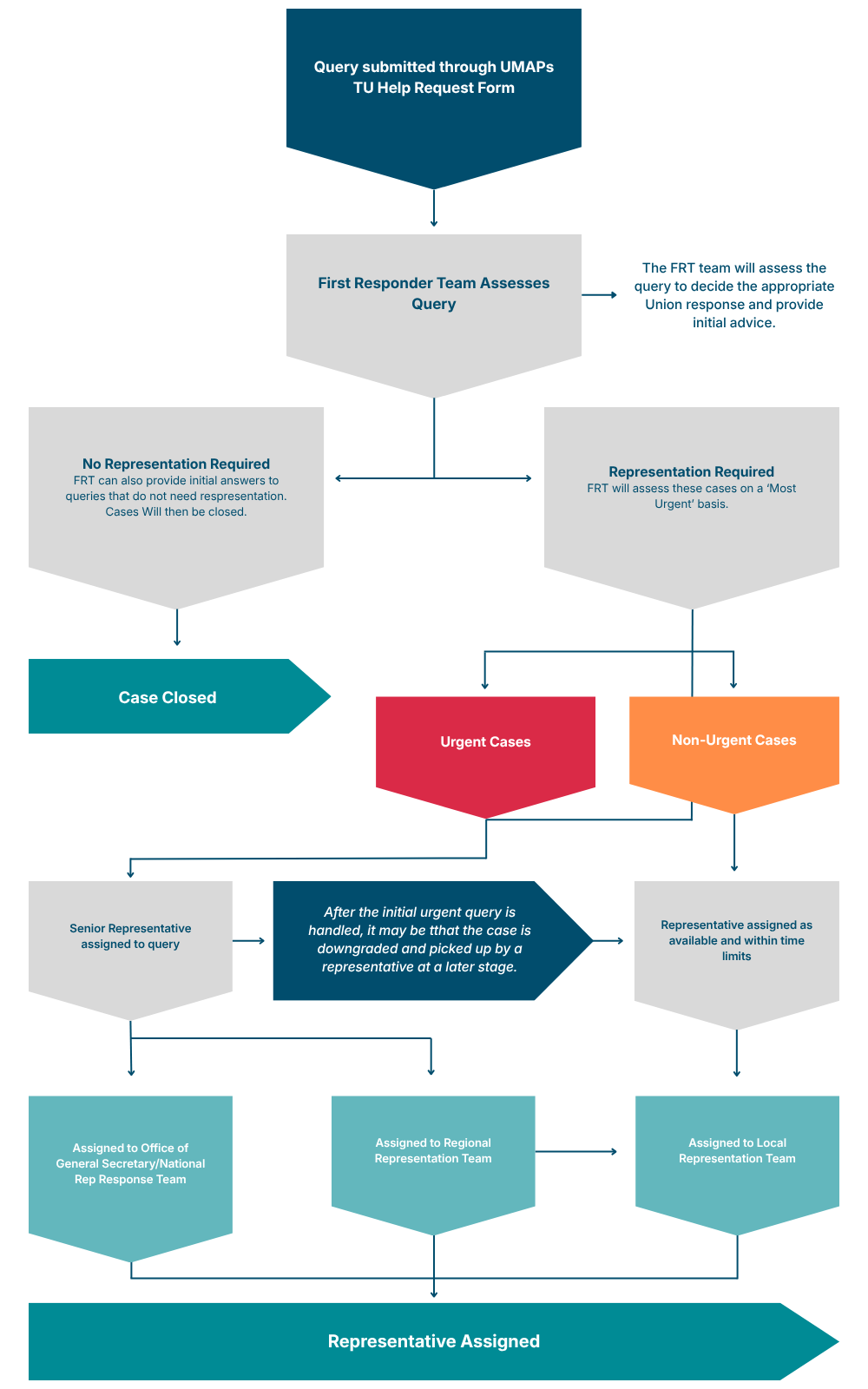
The representative will, at all times, seek to provide the member with the best available guidance with the aim of remediating the dispute, and will seek to maintain the trust and confidence between the employer and the member, whilst also protecting the members’ legal position.
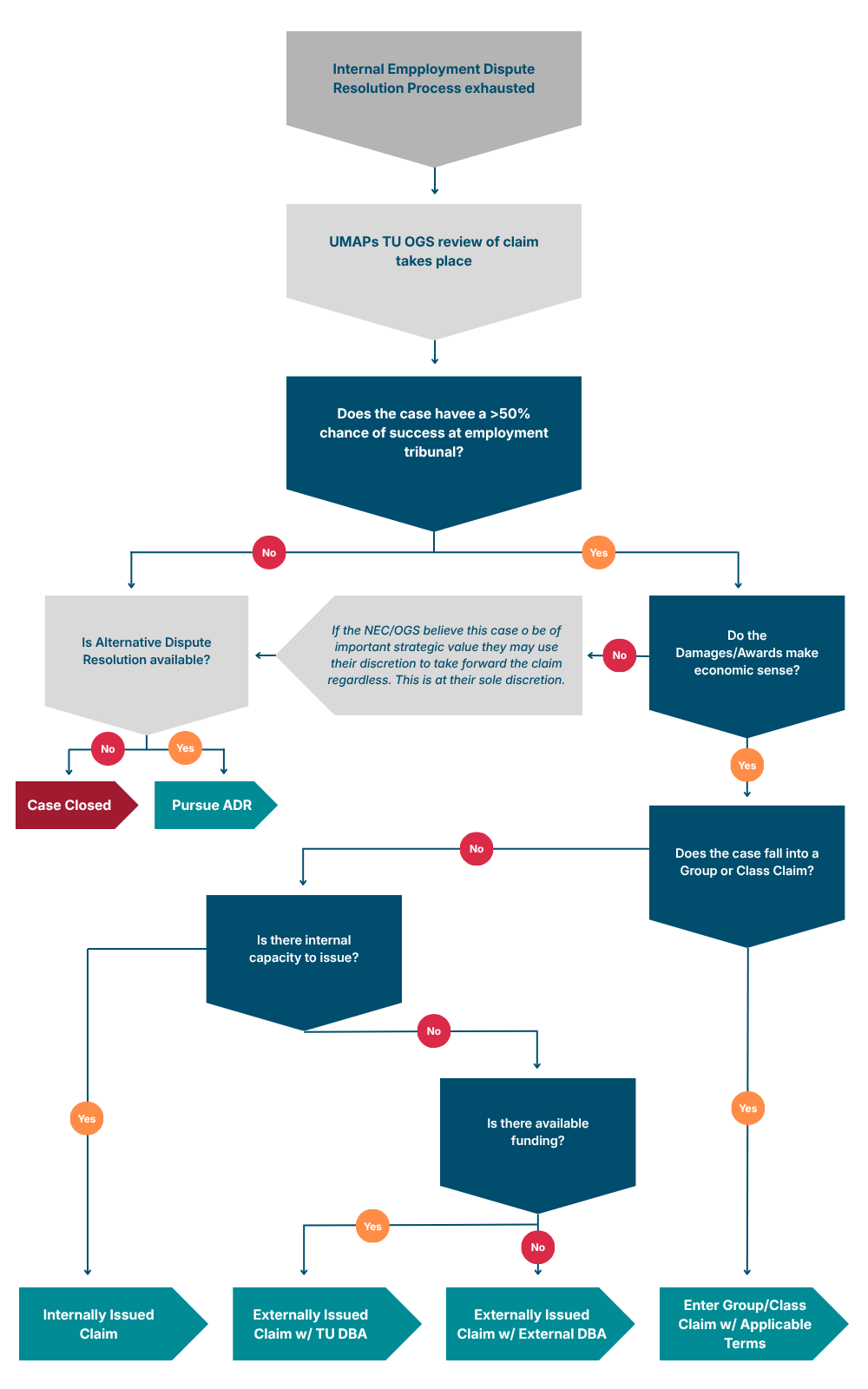
When any internal dispute resolution process is exhausted, the representative will determine the next course of action, which may include mediation or an Employment Tribunal claim. The decision process is as follows:
Role of the Representative
Members should expect that any representative assigned to their case will act with professionalism, discretion, and in alignment with the principles of fairness and due process. Representatives are voluntary professionals, offering peer-based advocacy in pursuit of fairness, natural justice and pursuit of a resolution of a members case. Their role is not to provide legal representation in the formal sense, but to guide, support, and advocate for members through employment or regulatory processes. They work to balance the best interests of the individual member with UMAPs policy and the wider protection of the profession.
The effectiveness of representation relies fundamentally on the member engaging in good faith, providing all relevant facts, maintaining honest communication, and following reasonable instructions. In periods of high demand, such as during case surges or coordinated employer actions, UMAPs operates a triage system that prioritises cases based on urgency and risk, with a focus on time-critical matters such as disciplinary hearings or statutory deadlines.
Representatives are assigned based on their geographical location and tier of experience. Local representatives are at the front door of UMAPs in the workplace and can handle most issues. Regional representatives are responsible for geographical areas and facilitate more complex conversations and interactions. National Rep Response Team representatives are advanced representatives with significant experience in multiple areas of employment law and disputes and are deployed by UMAPs at the request of the Office of the General Secretary to facilitate handling strategic and high stakes discussions/disputes.
Representatives have access to each other, and employment law specialist advice from instructed and internal legal teams on how best to position claims and respond to maximise protection. Whilst they may be the sole point of contact, the entire union is behind them and empowering them to facilitate the best outcome for the member.
Duties of the Member Receiving Representation in Internal or External Employment Disputes (‘Member Commitments’)
In order to receive representation, members agree to provide the following commitments in addition to the existing Duty of Candour:
- Members must maintain professionalism and respectful communication at all times when engaging with their Representative.
- Behaviour that is felt to be abusive, discriminatory, harassing, or otherwise inappropriate will not be tolerated and will result in the withdrawal of support.
- All communication must take place via email unless the Representative has expressly agreed to an alternative method, or subject to a reasonable adjustment.
- Communications should be limited to the specific case for which assistance has been requested.
- Members must be aware of professional boundaries when considering sharing any unrelated issues, personal grievances, or information outside the scope of the dispute.
- Members must respect the privacy of the Representative and the confidentiality of all communications.
- Case-related documents, correspondence, or advice must not be disclosed to third parties without explicit consent from UMAPs.
- Any breach of confidentiality may result in termination of support.
- Members are required to provide complete and honest disclosure of all facts, documents, and communications relevant to your case. Failure to do so, that results in loss of trust or confidence of, or reputational harm to UMAPs and/or the Representative will be considered misconduct and subject to investigation and/or the withdrawal of representation.
- Members must inform UMAPs immediately of any involvement, advice, or actions taken by other organisations, representatives, or professional bodies regarding the same matter.
- Members must keep their Representative fully informed of any updates, developments, or correspondence relating to their case.
- Members must cooperate fully with their Representative, including providing timely responses to requests for information.
- Members must agree to act in accordance with the guidance and advice provided by their Representative. Failure to follow the advice of the Representative may result in representation being withdrawn and any further cover denied for this incident.
- UMAPs’ support will be limited to the specific case under discussion.
- Support may be withdrawn if these Terms and Conditions are breached, or if the Representative reasonably believes continued involvement is not appropriate.
- UMAPs are not liable for any outcome arising from a member’s failure to follow advice or disclose relevant information.
- Responsibility for the progression of any case rests primarily with the Member. Accordingly, it is the Member’s duty, albeit with guidance and support from UMAPs, to monitor applicable time limits, pursue relevant outcomes, and prepare all necessary statements and correspondence.
- UMAPs cannot accept responsibility for isolated support requests made during peak periods which are not subsequently pursued by the member, where such inaction results in the expiry of legal deadlines or statutory limitation periods.
Eligibility for Continuing Access to DEDA & DSIC
To be able to be considered for ongoing representation under DEDA the member must be, and remain throughout the period of the dispute, a fully paid-up member with UMAPs. The member is permitted to explore an alternative membership category, providing that category covers for Employment Dispute Resolution.
If the claim concerns Professional Registration, Regulatory matters or is a Criminal claim related to their professional role, then they must maintain membership within a category that covers them for this type of dispute, throughout the duration of the dispute. Should the member, at any point, default on their membership payments, UMAPs reserve the right to withdraw any further assistance and seek payment in full for the annual membership together with any costs incurred in relation to the claim.
Proceeding to Employment Tribunal
Proceeding to Employment Tribunal
For cases to proceed to employment tribunal, they will first be subject to both a merits and cost assessment. Cases can be progressed at UMAPs discretion, taking into account cost, expected damages and strategic value, and providing the member is in good standing and is in agreement with any additional terms in relation to proceeding. Depending on the nature of the case, it may be more suitable to proceed through a group claim or class action, for which specific terms will apply.
If the claim does not fit into group or class criteria, then it may be issued internally or through the appointment of an external firm of solicitors. In the event of a claim being issued, the cost of the merits assessment may be covered, at UMAPs discretion. Based on this assessment and the potential of damages being positive, UMAPs will, at its discretion, then seek to pursue the claim on a Damages Based Assessment agreement either covered by UMAPs or by the firm engaged. This means that the member agrees to pay either a fixed amount or fixed percentage out of the damages or settlement awarded, towards UMAPs or the external firms costs.
In some cases, there may be a downpayment required from UMAPs, or from the member, for access to group, class or specific claims for merits assessments. If the member subsequently withdraws from their claim against UMAPs or the firms advice, then they will be required to reimburse UMAPs for any costs incurred.
Nature of Support and No Guarantee of Outcome
Any representation, advice, guidance, or support provided by UMAPs or its representatives is provided on a peer-support and advocacy basis and does not constitute legal advice. Legal advice is provided only where a qualified legal professional is instructed to act on the members behalf. UMAPs does not guarantee any particular outcome, decision, settlement, award, or timescale in relation to any claim which it supports.
Limitation of Liability
Any representation, advice, guidance, or support provided by UMAPs or its representatives is provided on a peer-support and advocacy basis and does not constitute legal advice. Legal advice is provided only where a qualified legal professional is instructed to act on the members behalf. UMAPs does not guarantee any particular outcome, decision, settlement, award, or timescale in relation to any claim which it supports.
To the fullest extent permitted by law, UMAPs shall not be liable for any loss, damage, cost, or expense sustained by a member, arising from or out of the provision of assistance or membership. In particular, UMAPs shall not, in any circumstances, be liable for any claim made by a Member for:
- any indirect, consequential, or economic loss, including loss of earnings, loss of opportunity, or reputational damage;
- any loss arising from reliance on advice, guidance, or representation provided by UMAPs representatives
- any failure to achieve a particular outcome; or
- any delay, omission, or limitation in the provision of support arising from triage, prioritisation, funding decisions, resource constraints or the awaiting of, or results of, decisions of the member.
Legal Fund & Discretionary Cover
What Does My Membership Cover?
Discretionary Cover
Discretionary Cover means that any decision to provide financial or legal support is made at the absolute discretion of UMAPs NEC. It does not constitute an insurance policy and does not create any contractual entitlement to payment or assistance.
This provision applies specifically to Discretionary Employment Dispute Assistance and Discretionary Secondary Indemnity Cover administered by UMAPs on behalf of its members.
The Legal Fund may, at the discretion of UMAPs, provide financial assistance for Solicitors and barristers disbursements and provides support to members who would otherwise be unable to access forms of legal recourse.
UMAPs reserves the right to recover any sums advanced from settlements and damages awarded through the pursuit of a claim. However, UMAPs may, at its absolute discretion, waive recovery of some or all of these sums where, in the reasonable opinion of UMAPs, recovery would cause significant financial hardship to the Member, including the Member’s dependents, where applicable.
Discretionary Employment Dispute Assistance (DEDA)
UMAPs provides Employment Dispute Assistance (DEDA) on a discretionary, claims-made basis. DEDA is not an insurance policy and there is no contractual entitlement to funding or to representation.
A claim will only be considered for discretionary cover where it first arises and is notified during a period of active membership. Claims notified outside of this will not be considered for cover.
Cover for an employment-related legal claim is subject to UMAPs being satisfied, amongst other things that:
- The claim has reasonable prospects of success, being assessed as greater than 51% likelihood of success;
- The likely damages or remedies to be awarded materially outweigh the anticipated costs of pursuing the claim;
- The member agrees to the duty to always co-operate with UMAPS/external lawyer; and
- The member agrees that UMAPs right to insist on settlement and can withdraw from funding at any stage.
Where a claim concludes successfully, UMAPs reserves the right to recover costs from any settlement, award of damages, or other outcome that it incurred by supporting the claim.
Where legal services are provided by an external legal provider appointed by UMAPs, such provider may act under a damages-based agreement or other contingent arrangement and may seek recovery of its costs on that basis. These terms will be explicitly explained at the point of such an arrangement and must be accepted prior to a claim being issued.
Where a claim arises from policy decisions, legislative changes, or other matters affecting the Membership as a whole, UMAPs reserves the right to exclude such claims from consideration for individual DEDA cover and may determine that the matter is to be progressed as a collective, group, or class action, on such terms that UMAPs shall in its absolute discretion deem appropriate.
UMAPs TU reserves the right to deploy Legal Fund resources and membership fees to support the strategic costs of any such collective or group claims, while maintaining appropriate access to legal action for affected members through alternative structures.
Mass Dispute Events, Group Disbursement Pool, Contributions, and Recovery Limits
UMAPs recognises that certain disputes may arise on a widespread basis affecting multiple members, including where matters are connected by a common policy position, employer practice, sector-wide change, or coordinated action.
Where, in the reasonable opinion of UMAPs National Executive Committee (NEC), a matter constitutes or forms part of a Mass Dispute Event, and where assessing and/or funding such matters on an individual basis would materially risk the Legal Fund, UMAPs’ operational continuity, or UMAPs’ ability to support the wider membership, UMAPs reserves the right, acting through the NEC and at its absolute discretion, to do any one or more of the following:
- Determine that the matter will not be considered for, or will cease to be considered for, individual discretionary cover under DEDA (or any other individual discretionary funding pathway);
- Require that the matter be progressed, if at all, only through a collective route determined by UMAPs (including, without limitation, a coordinated approach, group claim, test case structure, or other strategic mechanism), on such terms as the NEC considers appropriate; and/or
- Impose funding controls, including limits, prioritisation, staging, phased approvals, or suspension, where the NEC reasonably considers such measures necessary to protect the Legal Fund and prevent or reduce the risk of insolvency or material financial harm to UMAPs; and/or
- Require participation only on additional terms, including member contributions towards Disbursements and/or other costs.
The NEC may exercise the discretion described above at any time, including after a matter has been notified and/or support has commenced, where the NEC reasonably considers such action necessary to protect the Legal Fund and/or UMAPs’ sustainability and duties to the wider membership.
For the purposes of this section:
- “Mass Dispute Event” means a dispute, set of claims, or series of connected matters which, in the reasonable opinion of the NEC, affects or is likely to affect multiple members and gives rise to a material funding risk to the Legal Fund if progressed and/or funded on an individual basis;
- “Disbursements” means external and case-specific out-of-pocket costs reasonably incurred in the pursuit, defence, or resolution of a matter, including (without limitation) counsel’s fees, expert fees, medical record fees, transcription, and other third-party charges. Disbursements do not include the internal time costs of UMAPs representatives;
- “Gross Damages or Settlement Sum” means the total gross sum paid to the member by way of damages, compensation, or settlement (however described), excluding any separate sums expressly allocated and paid to legal representatives in respect of costs; and
- “Actual Litigation Cost” means the total of the external legal and case costs actually incurred and paid or advanced by UMAPs in connection with the member’s participation in the Mass Dispute Event (including solicitor fees where funded by UMAPs, counsel fees, and Disbursements), net of any sums recovered inter partes from the opposing party and/or otherwise reimbursed to UMAPs.
Group Disbursement Pool
Where UMAPs agrees to support a Mass Dispute Event, UMAPs may establish a Group Disbursement Pool for the purpose of meeting Disbursements incurred across the Mass Dispute Event. The NEC may determine, at its absolute discretion, how Disbursements are budgeted, allocated, prioritised, and paid, including whether Disbursements are treated as shared group costs, individual case costs, or a combination of both.
Where a Group Disbursement Pool is established, the NEC may determine a fair and reasonable allocation methodology for attributing pooled Disbursements to participating members, including (without limitation) equal apportionment, apportionment by litigation stage reached, and/or apportionment by relative resource intensity.
Post Hoc Recovery From Damages In Mass Dispute Events
Where UMAPs has funded or advanced Disbursements (in whole or in part) and/or legal costs in a Mass Dispute Event, or has waived or deferred a required member contribution in relation to a Mass Dispute Event, UMAPs reserves the right to recover sums advanced from the member from any damages, compensation, or settlement arising from the claim, subject always to the following limitations, which apply only to Mass Dispute Events:
1. Total Deduction Cap
The combined total of:
- any solicitor contingent deductions taken from the member’s Gross Damages or Settlement Sum (including any damages-based agreement percentage, success fee, or equivalent arrangement), and
- any recovery by UMAPs from the member taken from the member’s Gross Damages or Settlement Sum,
shall not exceed 45% of the Gross Damages or Settlement Sum, so that the member retains not less than 55% of the Gross Damages or Settlement Sum.
2. Actual Cost Cap (never more than actual cost)
In no circumstances shall UMAPs recover from the member (whether from damages or settlement, from any required contribution, or by any combination of the two) more than the Actual Litigation Cost attributable to that member, as determined by UMAPs acting reasonably and evidenced by appropriate invoices and/or accounts records.
3. Aggregate Recovery Headroom
Subject to paragraphs 1 and 2, UMAPs may recover from the member’s Gross Damages or Settlement Sum such amount (whether calculated by reference to a percentage and/or fixed sum) as is necessary to reimburse UMAPs for Actual Litigation Cost, provided that UMAPs’ recovery from the member’s Gross Damages or Settlement Sum shall not exceed the headroom available after taking into account any solicitor contingent deductions, up to a maximum combined deduction of 45% of the Gross Damages or Settlement Sum.
For the avoidance of doubt:
- where the solicitor contingent deductions are less than 35% of the Gross Damages or Settlement Sum, UMAPs may, if Actual Litigation Cost justifies it, recover the difference up to the maximum combined deduction cap of 45%; and
- where the solicitor contingent deductions are 35% or more of the Gross Damages or Settlement Sum, UMAPs’ recovery from the member’s Gross Damages or Settlement Sum will be correspondingly reduced so as not to exceed the maximum combined deduction cap of 45%.
4. Inter Partes Costs
For the avoidance of doubt, the limitations above apply only to sums deducted from the member’s Gross Damages or Settlement Sum and do not restrict the recovery of legal costs payable by the opposing party to the member’s legal representatives (inter partes costs), nor do they prevent UMAPs from agreeing, at its absolute discretion, to waive or reduce recovery where repayment would cause significant hardship.
5. Discretion To Recover Less
UMAPs may, at its absolute discretion, recover less than the maximum permitted under this section, including (without limitation) where UMAPs considers it fair and reasonable to do so, where recovery would cause hardship, and/or where UMAPs determines that writing off some or all unrecovered sums is necessary or appropriate for the effective management of the Mass Dispute Event and the Legal Fund.
Direct Funding Outside Mass Dispute Events
Nothing in this section limits UMAPs’ right, where it directly funds litigation for a member outside a Mass Dispute Event (whether under DEDA or DSIC), to seek recovery in accordance with the member-specific and/or case-specific terms issued and agreed at the time that funding is approved.
Members must maintain continuous membership for the duration of any live claim in order to remain eligible for DEDA support. If membership lapses throughout this period UMAPs reserves the right to recover the costs from the Member.
Subject to the above, where cover is approved, UMAPs may provide assistance with funding to meet some or all of the upfront costs on a discretionary basis and subject to an overall maximum limit of £100,000 per claim, inclusive of any appeal.
Discretionary Secondary Indemnity Cover (DSIC)
UMAPs provides Discretionary Secondary Indemnity Cover (DSIC) on an occurrence-based basis. DSIC is not an insurance policy and does not create any contractual entitlement to indemnity or representation.
Subject to the provisions of this section, a claim may be considered for discretionary support where the incident giving rise to the claim occurred during a period in which the member has a membership including DSIC, regardless of when the claim is first made or notified.
UMAPs reserves the right to refuse, withdraw, or limit DSIC support at its absolute discretion including, but not limited to the following where:
- there is evidence of malice, dishonesty, or a breach of the duty of candour by the member;
- the member is in bad standing with UMAPs as per the rulebook;
- the member has breached, the UMAPs Code of Conduct, Complaints and Disciplinary Procedure Policy or applicable policies;
- the member is not fully paid up in respect of subscriptions or any other required payment due to UMAPs
- the member has failed in the reasonable opinion of UMAPs to notify it of an incident which they knew, or ought reasonably to have known, may give rise to a claim,
Primary Indemnity Requirements
Members practising within the NHS or UK primary care settings are ordinarily covered by the Clinical Negligence Scheme for Trusts (CNST) or the Clinical Negligence Scheme for General Practice (CNSGP). These schemes provide primary indemnity in respect of compensation or damages payable to patients arising from clinical negligence and are regarded as the primary indemnity required for regulatory purposes.
Members practising in the private sector must maintain appropriate primary medical indemnity or insurance that provides cover for damages payable to patients in the event of a successful claim. Failure to maintain adequate primary indemnity may result in refusal of DSIC support.
Scope Of DSIC Assistance
DSIC may provide discretionary support in respect of the following costs arising from the member’s professional practice as a Medical Associate Professional:
- Support and representation in proceedings before the General Medical Council and the Medical Practitioners Tribunal Service, where applicable to the member’s role and scope of practice;
- Support and representation in Coroner’s Court proceedings;
- Support and representation in criminal proceedings arising directly from the member’s professional practice;
- Cover for costs of defending a claim relating to “Good Samaritan” acts within the United Kingdom in respect of emergency assistance provided outside contracted employment, subject to applicable policy terms.
Initial Regulatory Correspondence
DSIC may also provide discretionary cover for the costs of an initial response to correspondence or a complaint from the General Medical Council, up to a maximum of £5,000 (Inclusive of VAT). This limited support is intended to assist members in responding appropriately at an early stage and to reduce the risk of escalation to formal regulatory proceedings.
Members must notify UMAPs immediately upon receipt of any correspondence from the General Medical Council or any other body of a disciplinary or regulatory nature.
Financial Limit
DSIC support is subject to an overall limit of £100,000 (inclusive of VAT) for all claims arising from or out of the same, or a series of connected incidents.
What Is The UMAPs Legal Fund
The UMAPs Legal Fund is a dedicated fund established and administered in trust by UMAPs, acting through UMAPs Ltd.
The Legal Fund is funded by contributions from membership subscriptions, together with such levies, donations, or other income as may be received by UMAPs from time to time. All monies paid into the Legal Fund are held in trust and applied solely for the purposes determined by UMAPs in accordance with its rules, policies, and governing documents.
The Legal Fund is used, on a discretionary basis, to support legal actions and legal costs that are considered by UMAPs to be in the best interests of protecting and advancing the Medical Associate Professions, including (without limitation):
- the provision of discretionary employment dispute assistance (DEDA)
- the provision of discretionary secondary indemnity cover (DSIC); and
- the funding of strategic, collective, group, or individual legal actions.
Access to, and use of, the Legal Fund is discretionary. Contributions to the Legal Fund do not create any contractual entitlement to funding, representation, or indemnity, and all decisions regarding the deployment of the Legal Fund are made at the sole discretion of UMAPs.
Moratorium + Pre-existing Claims
For DEDA and DSIC claims, UMAPs operates on a 4-week moratorium and has an active pre-existing claims policy, meaning that any dispute occurring prior to, or found to be initiated within 4-weeks of, purchasing membership, will not be covered as standard and will be subject to the pre-existing claims coverage policy. This may be updated by the treasury but has the following fallback positions.
- Any dispute occurring prior to, or within 4 weeks of purchasing membership will not be covered as standard and will be assessed and represented at UMAPs discretion.
- Any dispute falling under the pre-existing claims policy will be subject to a pre-existing claim fee, plus annual membership tie in.
- Any Legal Fund access will be limited to covering costs up front on a strict, full recovery basis.
Fair Usage of Legal Support and Professional Time
Where a member is granted access to legal support, including where the member enters into a separate agreement with a legal services provider introduced or arranged by UMAPs, such support is provided on a fair usage basis and is, at all times, subject to UMAPs’ discretion, and any applicable terms as set out in this document.
Legal support is intended to cover substantive legal work reasonably required for the progression, defence, or resolution of a member’s case.
UMAPs will not fund legal costs arising, in UMAPs reasonable opinion, from any excessive, unnecessary, or non-substantive communications by the Member, including but not limited to:
- Repeated requests for general updates where no material change has occurred;
- Reassurance-seeking or anxiety-driven communications that do not advance the legal matter;
- Communications duplicating information already provided;
- Contact that falls outside agreed communication channels or frequencies; or
- Any contact that the legal provider reasonably considers administrative, non-essential, or disproportionate.
Where a member’s use of legal support exceeds fair and reasonable usage, UMAPs reserves the right to require the member to meet the cost of additional legal work personally.
Nothing in this clause limits a member’s ability to respond to reasonable requests from their legal advisers or to engage meaningfully with their case. UMAPs retains sole discretion to determine what constitutes fair usage for the purposes of funding and support.
Supersession
1. These Terms and Conditions apply from the Effective Date stated on the UMAPs website and/or communicated to members and supersede and replace all previous versions of UMAPs membership terms and conditions (including any prior schedules, policies, or guidance documents to the extent they are incorporated into, or inconsistent with, earlier terms).
2. From the Effective Date, any reference to “terms and conditions” in membership communications, policies, or materials shall be construed as a reference to these Terms and Conditions (as amended from time to time).
3. Where a member’s membership was purchased or renewed under a prior version, that prior version shall cease to apply from the Effective Date, save that any case-specific or member-specific funding terms already agreed in writing (for example, in relation to DEDA and/or DSIC support for an existing live matter) shall continue to apply to that matter unless replaced by written agreement.
Variation and Amendment
4. UMAPs reserves the right to amend these Terms and Conditions at any time, acting through the National Executive Committee (NEC), where the NEC reasonably considers amendment necessary or desirable for operational, financial, governance, legal, regulatory, or member-service reasons, including for the introduction, modification, withdrawal, or reconfiguration of membership products, services, benefits, support pathways, and/or pricing structures.
5. Unless a shorter period is required under clause 6, UMAPs will provide members with not less than 30 days’ written notice of any material amendment. Notice may be given by email to the address held on the membership record and/or by publication on the UMAPs website and/or the member dashboard.
6. UMAPs may implement amendments with shorter notice or immediate effect where the NEC reasonably considers this necessary to:
- Comply with law, regulatory requirements, or directions;
- Address a material risk to the Legal Fund or UMAPs’ financial sustainability;
- Prevent fraud, misuse of benefits, or serious operational harm;
- Protect member data, security, or system integrity; and/or
- Enable the launch, modification, withdrawal, or urgent reconfiguration of membership products, services, benefits, or provider arrangements where this is required to implement the change effectively (including where dependent on third-party providers, insurers, or time-limited availability).
Where this clause applies, UMAPs will provide notice as soon as reasonably practicable.
7. A member’s continued membership after the effective date of an amendment shall constitute acceptance of the amended Terms and Conditions. If a member does not accept an amendment, the member may cancel in accordance with the cancellation provisions in these Terms and Conditions, and membership shall continue until the end of the then-current term (subject to payment of all sums due).
Membership Framework
Membership Management
Who Can Become A Member?
Membership of UMAPs is open to individuals who meet the eligibility requirements, as set out below. Eligibility criteria, rights, and benefits may vary depending on the category of membership applied for. Applicants for membership must ensure that they meet the specific eligibility requirements for the membership category they are seeking.
The following individuals are eligible for membership, subject to them satisfying the criteria applicable to the relevant membership category:
- Qualified Physician Associates
Individuals who have successfully completed a recognised Physician Associate qualification – and are not actively studying or working for another medical profession - Qualified Anaesthesia Associates
Individuals who have successfully completed a recognised Anaesthesia Associate qualification – and are not actively studying or working for another medical profession - Physician Associate /Anaesthesia Associate Students
Individuals currently undertaking a recognised course of study leading to qualification as a Medical Associate Professional (Physician Associate and Anaesthesia Associate programmes). - Temporarily Non-Practising or Non-Employed Members
Qualified Physician Associates and Anaesthesia Associates who are temporarily not- practicing as a Physician Associate/ Anaesthesia Associate due to redundancy, illness, caring responsibilities, a career break, or an inability to secure suitable employment. - Invited or Associate Members
Individuals who do not fall within the categories above but who support the aims and objectives of UMAPs and who have been invited to apply for membership by an existing member, subject to approval and any additional conditions set by UMAPs National Executive Committee (NEC).
UMAPs reserves the right to: request evidence of eligibility to determine the appropriate membership category and to amend or withdraw any membership category at any time.
Exclusions
No person shall be eligible for membership if any of the following apply:
- Previous Expulsion
The individual has previously been expelled from UMAPs or from the College of Medical Associate Professionals (CMAPs) . - Removal or Barring from the GMC Register
The individual has been struck off, barred from joining or otherwise unable to be on the General Medical Council Register, except where the individual is actively contesting the decision with the assistance and support of the UMAPs.
The determination of eligibility under this section shall rest with the NEC and such determinations shall be final.
How Do I Become A Member?
An individual may apply to become a member of UMAPs by completing the online membership application form available on the UMAPs website.
Applicants must select the appropriate category of membership and provide accurate, complete, and up-to-date information.
UMAPs reserves the right to: require verification of identity, professional status, student status, or any other relevant information to confirm eligibility.
Member Categories
Membership categories are defined in the Trade Union Rule Book to confer the rights of members that qualify for membership within each category. All membership products (i.e. the memberships you see on the website when purchasing your membership) will fall into a category that underpins the membership you have purchased and qualified for. The current Categories of membership are laid out below:
Ordinary Member
An Ordinary Member is a Medical Associate Professional who is eligible for full membership of UMAPs.
Ordinary Members hold full membership rights, which may include voting rights, eligibility to stand for elected positions, and access to the full range of member services and benefits, subject always to these Terms and Conditions. Ordinary Membership is subject to payment of the applicable subscription unless a waiver has been granted.
Memberships included in the Ordinary Member category:
- Founding
- Founding Essential
- Founding Comprehensive
- Basic (legacy)
- Professional (legacy)
- Essential
- Comprehensive
Career Gap and New Graduate Associate memberships can sometimes lead to temporary dual category status in order to entitle members to reduced rates/discounts and other support.
Associate Member
An Associate Member is a person who does not meet the eligibility criteria for Ordinary Membership but who is accepted into membership under the Associate category.
Associate Members do not hold voting rights and are not eligible to stand for elected offices within the ordinary networks. Access to Union services, representation, or benefits may be limited or conditional. Associate Members may be invited to participate in consultative or indicative processes at the discretion of UMAPs. They may also be able to stand for leadership positions but only within their Associate networks.
Additional eligibility requirements may apply to Associate Membership, including references or approval processes.
Memberships included in the Associate Member category:
- Career Gap
- New Graduate
- Student
Honorary Member
An Honorary Member is an individual who is granted membership by UMAPs in recognition of their contribution to, or support for, the aims and objectives of the organisation.
Honorary Membership is granted at the discretion of UMAPs NEC and may be subject to specific terms and conditions. Honorary Members do not hold voting rights, unless they remain active members of a concurrent ordinary network, and are not eligible to stand for elected office. Honorary Membership does not create any entitlement to services, representation, or benefits unless expressly stated in the membership description on the Schedule of Membership.
Memberships included in the Honorary Member category:
- Supporter
- Ex-Leaders Committee (not currently in use)
Honorary Member
An Honorary Member is an individual who is granted membership by UMAPs in recognition of their contribution to, or support for, the aims and objectives of the organisation.
Honorary Membership is granted at the discretion of UMAPs NEC and may be subject to specific terms and conditions. Honorary Members do not hold voting rights, unless they remain active members of a concurrent ordinary network, and are not eligible to stand for elected office. Honorary Membership does not create any entitlement to services, representation, or benefits unless expressly stated in the membership description on the Schedule of Membership.
Memberships included in the Honorary Member category:
- Supporter
- Ex-Leaders Committee (not currently in use)
Current Membership Offerings
The memberships summarised below are subject to the provisions of these Terms and Conditions, the Trade Union Rule Book, and applicable policies.
Essential Membership
Essential Membership is for qualified Physician Associates and Anaesthesia Associates who are practicing in, or experiencing a career gap (as defined on page 8) from, their network-based work environment (Secondary Care, Anaesthesia Associate, Primary Care, Educators). It includes DEDA, employment advice and representation (subject to eligibility), wellbeing support, member communications, and participation in UMAPs governance and activities. Full benefits will be listed and kept up to date in the product description at the time of taking out the membership.
Comprehensive Membership
Comprehensive Membership is for qualified Physician Associates and Anaesthesia Associates who seek enhanced support which includes professional secondary indemnity coverage (DEDA and DSIC). In addition to all Essential Membership benefits listed in the product description, this membership also includes access to regulatory and medico-legal, coronial, or criminal proceedings arising from professional practice, subject to policy terms and provider conditions discussed later in this policy.
New Graduate Membership
New Graduate Membership is for newly qualified Physician Associates and Anaesthesia Associates within their first year of clinical practice. It provides a time-limited membership offering core professional advocacy, employment support, and wellbeing resources to support transition into practice, subject to eligibility and applicable policies for a period of 1 year of their first clinical practice; starting at the point of their employment not graduation. This membership is a supplementary associate level network entitlement that provides the member with discount but also requires that they are attached to a primary ordinary network if clinically active as an Associate.
Student Membership
Student Membership is for individuals undertaking a recognised course of study leading to qualification as a Medical Associate Professional. It provides access to professional advocacy, wellbeing support, member communications, and selected advice services appropriate to student status. Proof of student status is required, and the membership falls within the associate member category.
Career Gap Status
Career Gap Status is an Associate Membership for qualified Physician Associates and Anaesthesia Associates who are temporarily not in employment due to redundancy, illness, caring responsibilities, career break, or inability to secure suitable employment, in order to facilitate their continued membership and benefits.
For members qualifying for this status who were in a standing network (Anaesthesia, Primary Care/Secondary Care/Educators), you will retain membership of the original Ordinary Member category and gain dual Associate Member status to entitle you to the benefits of this membership. You will retain membership within the standing network you were in at the point the gap occurred. You will retain all benefits of membership within your original category (except DSIC for new disputes occurring within the gap period that don’t relate to previous clinical work) including the right to vote, represent and stand for leadership positions. You will need to update UMAPs the moment you intend not to return from your career gap or if you do successfully return to your network or a new primary network.
For Members who were not yet able to obtain work and gain membership within a Standing Network, you will retain only Associate Member Status within the New Grad Network. You will be able to gain the rights to ordinary member status the moment you gain employment in a primary network.
This status provides access to collective professional advocacy and a range of wellbeing, advisory, and support services as per the product description on the website. This membership does not include workplace representation, regulatory representation, or indemnity cover under DEDA or DSIC Coverage as an Associate Member.
Supporter Membership
Supporter Membership is for individuals who support the aims of UMAPs, including family members, friends, and invited supporters. It provides benefits such as access to update communications and wellbeing and advisory services but does not confer professional status, voting rights, representation, indemnity, or advocacy. These benefits can be altered at the NEC’s discretion from time to time.
Founding Membership
Founding Member is a limited offer for members who founded UMAPs. This membership entitles the member to the core benefits of the Essential membership but does not grant access to DEDA or DSIC policies without topping up to either Founding Members Essential or Comprehensive memberships.
Founding Membership – Essential
Founding Members Essential is a legacy form of membership offered to individuals recognised as Founding Members of UMAPs. It provides the same benefits as Essential Membership, subject to the terms, conditions, and eligibility requirements applicable at the time of enrolment.
Available only to ‘Founding Member’ status holders.
Founding Membership – Comprehensive
Founding Members Comprehensive is a legacy form of membership for Founding Members. It provides the same enhanced benefits as Comprehensive Membership, including potential access to regulatory, medico-legal, and insurance-related support, subject to applicable policies and provider terms.
Available only to ‘Founding Member’ status holders.
Legacy Memberships (no longer open to new members)
Basic Membership (legacy)
- DEDA: Expert advice and representation for employment contracts and professional issues. Also entitles the member to DEDA policy.
- Grievance Support: Assistance with disputes about terms, conditions, remuneration, and handling complaints like bullying or discrimination.
- Disciplinary Representation: Support in performance and capability assessments, including defence in disciplinary processes.
- Professional Advocacy: Dedicated PR and advocacy to protect your professional reputation.
- Education Platform: Access to free CPD courses, monthly seminars, and weekly challenges to enhance your skills.
- Safe Online Community: A secure space to connect with peers and reduce professional isolation.
- Part-time Indemnity: Tailored indemnity options for part-time clinical workers.
Professional Membership (legacy)
- DSIC: Discretionary Secondary Indemnity protection for your professional practice.
- DEDA: Expert advice and representation for employment contracts and professional issues. Also entitles the member to DEDA policy.
- Grievance and Disciplinary Support: Assistance with disputes, complaints, and disciplinary processes.
- Advanced Education Platform: Unlimited access to CPD courses, seminars, and interactive challenges.
- Secure Online Community: Connect with colleagues in a safe and supportive environment.
- Legal Representation: Defence in employment-related legal actions.
- Enhanced Indemnity: Secondary medical indemnity for NHS work.
Membership Structure
At the time of taking out our memberships, the application page will make clear which type of payment term structure the membership incurs. For clarity, the Payment terms will be written on the Membership Schedule.
Membership Term
All annual memberships are entered into as a 12-monthly automatically renewing contract paid on a monthly basis.
The initial minimum term of membership is twelve months from the date the membership commences.
Following the initial minimum term, the membership will continue on a rolling basis and will automatically renew for the next 12-month term unless cancelled in accordance with the cancellation provisions below.
Fixed Term Membership
A Fixed Term Membership is a membership that is granted for a specified, defined period.
- Fixed Term Membership commences on the date of purchase or activation and continues for the agreed duration only.
- Fixed Term Membership does not automatically renew at the end of the term unless expressly stated at the time of purchase.
- At the expiry of the fixed term, the membership shall automatically lapse unless the member elects to renew or transfer to another available membership category.
- Rights, benefits, and services associated with Fixed Term Membership apply only for the duration of the fixed term and are subject to the Trade Union Rule Book , Terms and Conditions, and applicable policies.
Rolling Membership
A Rolling Membership is an ongoing membership that continues indefinitely unless terminated in accordance with the Terms and Conditions laid out specifically within that product description.
- Rolling Membership automatically renews at the end of each billing period, typically on a monthly basis.
- Subscription fees are payable at the applicable rate for the membership category and are collected on a recurring basis.
- Members may terminate a Rolling Membership by providing the required notice, stipulated within that products description and schedule, in accordance with UMAPs cancellation and termination provisions.
- UMAPs reserves the right to amend subscription rates or membership terms for Rolling Membership, subject to reasonable notice to members.
Legacy Membership
A Legacy Membership is a membership category or subscription arrangement that is no longer offered to new members but continues to be recognised for existing members.
- Legacy Memberships are retained under the terms, pricing, and benefits applicable at the time the membership was originally granted, unless otherwise notified.
- UMAPs may amend or withdraw Legacy Memberships where required for legal, regulatory, or organisational reasons, subject to reasonable notice.
- Members holding a Legacy Membership may be required to transfer to a current membership category if the Legacy Membership is discontinued.
- Legacy Memberships are not available to new members and are maintained at the discretion of UMAP’s NEC.
Cancellation & Payment Terms
Cancellation and Termination by the Member
- Members may give notice to cancel their membership at any time during the 12-month term, or within a 14-day cooling off period after the purchase/renewal date, by providing written notice through the account page on the UMAPs website (https://umaps.org.uk/my-account/).
- Cancellation will take effect at the end of the current 12-month term, and membership benefits will continue until that date.
- Failure to cancel in accordance with this clause will result in the membership automatically renewing for a further 12-month term, if the membership is a rolling membership, with the member remaining liable for the applicable subscription fees for that term.
Failure to Cancel
- If a member does not cancel their membership in accordance with these Terms and Conditions, the membership will continue on a rolling basis and subscription payments will remain due.
- UMAPs will not be responsible for continued charges arising from a failure to follow the cancellation process set out above.
Changes to Fees or Terms
- UMAPs reserves the right to amend subscription fees or membership terms.
- Any changes to prices will be voted on by the NEC and will be the result of business need and subject to adequate notice to membership.
- UMAPs TU reserves the right to maintain prices in line with inflation.
Direct Debit Payments
Where a member elects to pay membership subscriptions, Legal Fund contributions, levies, donations, or any other sums due to UMAPs by Direct Debit, the member authorises UMAPs, or its appointed payment processor, to collect the relevant payments from the bank or building society account nominated by the member.
Direct Debit payments will be collected in accordance with the member’s selected membership product, payment frequency, and the Direct Debit Guarantee. UMAPs will provide advance notice of the amount, collection date, and frequency of payments, and of any material change to those details, in accordance with the Direct Debit scheme rules.
The member is responsible for ensuring that their Direct Debit remains active and that sufficient funds are available. Where a Direct Debit is rejected, recalled, cancelled, or otherwise fails, the member remains liable for all sums due under their membership contract.
Cancellation of a Direct Debit does not constitute cancellation of membership, termination of the membership contract, or waiver of any sums already due to UMAPs. Members wishing to cancel membership must do so in accordance with the cancellation provisions set out in these Terms and Conditions.
UMAPs may suspend access to membership benefits, representation, DEDA, DSIC, Legal Fund support, or other services where payment has failed or remains outstanding. Access may be reinstated once all outstanding sums have been paid and the member is otherwise in good standing.
Where an error is made in the collection of a Direct Debit, the member may be entitled to a refund under the Direct Debit Guarantee. Where a refund is obtained in circumstances where the sum was properly due to UMAPs, the member remains liable to repay that sum on request.
Cancellation of Direct Debit Without Notice
- Cancellation of a Direct Debit or other recurring payment method does not constitute cancellation of membership or termination of the membership contract.
- Where a member cancels or fails to maintain a Direct Debit or other payment method without giving notice in accordance with these Terms and Conditions, the membership contract shall remain in force but any benefits of the contract will be suspended and coverage under DEDA and DSIC suspended until fully paid up.
- The member shall remain liable for all subscription fees due under the membership contract up to the effective date of cancellation in accordance with the applicable notice and term provisions in the Membership Schedule.
- UMAPs reserves the right to:
- Suspend access to membership benefits and services while payment remains outstanding;
- Recover any outstanding subscription fees in accordance with these Terms and Conditions; and
- Require the member to reinstate payment or settle outstanding sums before access to services is restored.
- Where a Direct Debit is cancelled without notice, UMAPs will make reasonable attempts to contact the member using the contact details held on record to resolve the matter.
- Persistent non-payment or failure to regularise outstanding fees may result in termination of membership in accordance with UMAPs’ Trade Union Rule Book/Code of Conduct, Complaints and Disciplinary Procedure Policy, without prejudice to UMAPs’ right to recover any sums lawfully due.
Duty of Candour
Applicants for membership and members of UMAPs are under a continuing duty of candour to provide complete, accurate, and truthful information when requested by UMAPs, including for the purposes of assessing eligibility, determining membership category, administering benefits, or managing disputes or legal support.
Members are required to notify UMAPs promptly of any material change in circumstances that may affect their eligibility, membership status, or access to Union support.
Failure to provide requested verification, or the provision of false, misleading, or incomplete information, whether by act or omission, including at sign up, may result in refusal of membership, suspension of membership, or termination of membership in accordance with UMAPs Rule Book and Code of Conduct, Complaints and Disciplinary Procedure Policy.
Where a member’s failure to comply with the duty of candour relates to matters of indemnity, regulatory proceedings, or criminal investigations or convictions, UMAPs reserves the right to:
- Refuse or withdraw access to disputes cover, legal support, or any other discretionary assistance;
- Treat any related indemnity or support as void;
- Recover costs that were incurred in providing services, representation and advice that is compromised due to the misrepresentation;
- Suspend or terminate membership; and/or
- Take such further action as is permitted under the Trade Union Rule Book and applicable policies.
The duty of candour applies on application and throughout the period of membership.
Assignment and Transfer
Membership and any rights arising under these Terms and Conditions are personal to the member and may not be assigned, transferred, or shared.
UMAPs reserves the right to transfer or delegate the administration of membership, Legal Fund management, or service provision to affiliated entities, trustees, or third-party providers without affecting the validity of the membership.
Governing Law and Jurisdiction
These Terms and Conditions, and any dispute or claim arising out of or in connection with them, shall be governed by and construed in accordance with the law of England and Wales.
The courts of England and Wales shall have exclusive jurisdiction to settle any dispute or claim arising out of or in connection with these Terms and Conditions.
Data Protection and Confidentiality
UMAPs will process personal data in accordance with applicable data protection legislation, including the UK General Data Protection Regulation and the Data Protection Act 2018.
Membership necessarily involves the processing and, where required, the sharing of personal and sensitive information with representatives, legal advisers, insurers, service providers, trustees, and third parties for the purposes of administering membership, representation, legal support, and discretionary cover.
Further information regarding how personal data is processed is set out in the UMAPs Privacy Notice, which forms part of these Terms and Conditions by reference.
Member Benefits & Access To Support
How Do Members Get Help?
UMAPs provides an array of benefits to members through internal provisions and external providers. To access these provisions, members must utilise the services as instructed throughout this document. UMAPs reserves the right to introduce new benefits and/or alter or withdraw existing benefits.
For employment disputes or concerns, including fitness to practise, members should use the Trade Union Help Request Form.
For mental health and wellbeing related concerns, members should use the EAP Contact Details.
For additional GP support, in instances where members feel they cannot approach their local GP, members can visit this page.
All forms and further information can be accessed through the account page: https://umaps.org.uk/my-account/
What Help Can Members Get?
Employee Assistance Program (EAP)
Mental and physical health provision is provided via external partners, and the details of the provision of care are available at the links above. These may change from time to time and are subject to review at UMAPs discretion:
As a UMAPs member, you and your family can access:
- Counselling support – 24/7 online, telephone, live chat, and in-person counselling.
- Critical incident support – trauma-trained counsellors available in emergencies.
- Cognitive Behavioural Therapy (CBT) – structured programmes, online resources, and telephonic CBT.
- Bereavement support – including counselling and legal guidance.
- Legal advice – consumer rights, housing, property, family law, wills, and more.
- Debt & financial support – including budgeting, credit, pensions, and financial coaching.
- Medical information – support from clinicians and access to a nationwide network of practitioners.
- Work-life advice – childcare, eldercare, relationships, and family challenges.
- For mental health support, a comprehensive service for use by yourself and friends or family, is available and includes the following:
Temporary Associate GP Access Program
For health issues related to the PA crisis whereby you feel unable to present to your local GP, there is a remote access pathway listed above that allows you to have remote review by GPs who are friendly to the PA profession and are safe to approach for related non-urgent mental health prescriptions. This is subject to funding and may be changed from time to time at UMAPs discretion.
Employment Dispute + Fitness to Practise
For applicable membership categories, UMAPs provides representatives to assist members through the process of employment disputes. This includes representation throughout consultation processes and mediation on any subject that materially affects members terms and conditions. The list below summarises the issues that a representative can be support with:
Internal :
- Capability
- Patient Complaint
- Disciplinary
- Dismissal/Termination
- Grievance
- Management of Change
- Maternity/Paternity
- Terms/Conditions/Pay (including proposed changes to terms and conditions of employment)
- Performance
- Redundancy
- Scope of Practice
- Sickness
- Whistleblowing
External:
- Regulatory
- Employment Tribunal
- Criminal Representation when in connection to Associate work
Representation Process
How Does UMAPs Handle Cases?
Upon submission of the Trade Union Help Request form, a case will progress as follows:
The representative will, at all times, seek to provide the member with the best available guidance with the aim of remediating the dispute, and will seek to maintain the trust and confidence between the employer and the member, whilst also protecting the members’ legal position.
When any internal dispute resolution process is exhausted, the representative will determine the next course of action, which may include mediation or an Employment Tribunal claim. The decision process is as follows:
Role of the Representative
Members should expect that any representative assigned to their case will act with professionalism, discretion, and in alignment with the principles of fairness and due process. Representatives are voluntary professionals, offering peer-based advocacy in pursuit of fairness, natural justice and pursuit of a resolution of a members case. Their role is not to provide legal representation in the formal sense, but to guide, support, and advocate for members through employment or regulatory processes. They work to balance the best interests of the individual member with UMAPs policy and the wider protection of the profession.
The effectiveness of representation relies fundamentally on the member engaging in good faith, providing all relevant facts, maintaining honest communication, and following reasonable instructions. In periods of high demand, such as during case surges or coordinated employer actions, UMAPs operates a triage system that prioritises cases based on urgency and risk, with a focus on time-critical matters such as disciplinary hearings or statutory deadlines.
Representatives are assigned based on their geographical location and tier of experience. Local representatives are at the front door of UMAPs in the workplace and can handle most issues. Regional representatives are responsible for geographical areas and facilitate more complex conversations and interactions. National Rep Response Team representatives are advanced representatives with significant experience in multiple areas of employment law and disputes and are deployed by UMAPs at the request of the Office of the General Secretary to facilitate handling strategic and high stakes discussions/disputes.
Representatives have access to each other, and employment law specialist advice from instructed and internal legal teams on how best to position claims and respond to maximise protection. Whilst they may be the sole point of contact, the entire union is behind them and empowering them to facilitate the best outcome for the member.
Duties of the Member Receiving Representation in internal or external employment disputes (‘member commitments’)
In order to receive representation, members agree to provide the following commitments in addition to the existing Duty of Candour:
- Members must maintain professionalism and respectful communication at all times when engaging with their Representative.
- Behaviour that is felt to be abusive, discriminatory, harassing, or otherwise inappropriate will not be tolerated and will result in the withdrawal of support.
- All communication must take place via email unless the Representative has expressly agreed to an alternative method, or subject to a reasonable adjustment.
- Communications should be limited to the specific case for which assistance has been requested.
- Members must be aware of professional boundaries when considering sharing any unrelated issues, personal grievances, or information outside the scope of the dispute.
- Members must respect the privacy of the Representative and the confidentiality of all communications.
- Case-related documents, correspondence, or advice must not be disclosed to third parties without explicit consent from UMAPs.
- Any breach of confidentiality may result in termination of support.
- Members are required to provide complete and honest disclosure of all facts, documents, and communications relevant to your case. Failure to do so, that results in loss of trust or confidence of, or reputational harm to UMAPs and/or the Representative will be considered misconduct and subject to investigation and/or the withdrawal of representation.
- Members must inform UMAPs immediately of any involvement, advice, or actions taken by other organisations, representatives, or professional bodies regarding the same matter.
- Members must keep their Representative fully informed of any updates, developments, or correspondence relating to their case.
- Members must cooperate fully with their Representative, including providing timely responses to requests for information.
- Members must agree to act in accordance with the guidance and advice provided by their Representative. Failure to follow the advice of the Representative may result in representation being withdrawn and any further cover denied for this incident.
- UMAPs’ support will be limited to the specific case under discussion.
- Support may be withdrawn if these Terms and Conditions are breached, or if the Representative reasonably believes continued involvement is not appropriate.
- UMAPs are not liable for any outcome arising from a member’s failure to follow advice or disclose relevant information.
- Responsibility for the progression of any case rests primarily with the Member. Accordingly, it is the Member’s duty, albeit with guidance and support from UMAPs, to monitor applicable time limits, pursue relevant outcomes, and prepare all necessary statements and correspondence.
- UMAPs cannot accept responsibility for isolated support requests made during peak periods which are not subsequently pursued by the member, where such inaction results in the expiry of legal deadlines or statutory limitation periods.
Eligibility for continuing access to DEDA & DSIC
To be able to be considered for ongoing representation under DEDA the member must be, and remain throughout the period of the dispute, a fully paid-up member with UMAPs. The member is permitted to explore an alternative membership category, providing that category covers for Employment Dispute Resolution.
If the claim concerns Professional Registration, Regulatory matters or is a Criminal claim related to their professional role, then they must maintain membership within a category that covers them for this type of dispute, throughout the duration of the dispute. Should the member, at any point, default on their membership payments, UMAPs reserve the right to withdraw any further assistance and seek payment in full for the annual membership together with any costs incurred in relation to the claim.
Proceeding to Employment Tribunal
Proceeding to Employment Tribunal
For cases to proceed to employment tribunal, they will first be subject to both a merits and cost assessment. Cases can be progressed at UMAPs discretion, taking into account cost, expected damages and strategic value, and providing the member is in good standing and is in agreement with any additional terms in relation to proceeding. Depending on the nature of the case, it may be more suitable to proceed through a group claim or class action, for which specific terms will apply.
If the claim does not fit into group or class criteria, then it may be issued internally or through the appointment of an external firm of solicitors. In the event of a claim being issued, the cost of the merits assessment may be covered, at UMAPs discretion. Based on this assessment and the potential of damages being positive, UMAPs will, at its discretion, then seek to pursue the claim on a Damages Based Assessment agreement either covered by UMAPs or by the firm engaged. This means that the member agrees to pay either a fixed amount or fixed percentage out of the damages or settlement awarded, towards UMAPs or the external firms costs.
In some cases, there may be a downpayment required from UMAPs, or from the member, for access to group, class or specific claims for merits assessments. If the member subsequently withdraws from their claim against UMAPs or the firms advice, then they will be required to reimburse UMAPs for any costs incurred.
Nature of Support and No Guarantee of Outcome
Any representation, advice, guidance, or support provided by UMAPs or its representatives is provided on a peer-support and advocacy basis and does not constitute legal advice. Legal advice is provided only where a qualified legal professional is instructed to act on the members behalf. UMAPs does not guarantee any particular outcome, decision, settlement, award, or timescale in relation to any claim which it supports.
Limitation of Liability
Any representation, advice, guidance, or support provided by UMAPs or its representatives is provided on a peer-support and advocacy basis and does not constitute legal advice. Legal advice is provided only where a qualified legal professional is instructed to act on the members behalf. UMAPs does not guarantee any particular outcome, decision, settlement, award, or timescale in relation to any claim which it supports.
To the fullest extent permitted by law, UMAPs shall not be liable for any loss, damage, cost, or expense sustained by a member, arising from or out of the provision of assistance or membership. In particular, UMAPs shall not, in any circumstances, be liable for any claim made by a Member for:
- any indirect, consequential, or economic loss, including loss of earnings, loss of opportunity, or reputational damage;
- any loss arising from reliance on advice, guidance, or representation provided by UMAPs representatives
- any failure to achieve a particular outcome; or
- any delay, omission, or limitation in the provision of support arising from triage, prioritisation, funding decisions, resource constraints or the awaiting of, or results of, decisions of the member.
Legal Fund & Discretionary Cover
What Does My Membership Cover?
Discretionary Cover
Discretionary Cover means that any decision to provide financial or legal support is made at the absolute discretion of UMAPs NEC. It does not constitute an insurance policy and does not create any contractual entitlement to payment or assistance.
This provision applies specifically to Discretionary Employment Dispute Assistance and Discretionary Secondary Indemnity Cover administered by UMAPs on behalf of its members.
The Legal Fund may, at the discretion of UMAPs, provide financial assistance for Solicitors and barristers disbursements and provides support to members who would otherwise be unable to access forms of legal recourse.
UMAPs reserves the right to recover any sums advanced from settlements and damages awarded through the pursuit of a claim. However, UMAPs may, at its absolute discretion, waive recovery of some or all of these sums where, in the reasonable opinion of UMAPs, recovery would cause significant financial hardship to the Member, including the Member’s dependents, where applicable.
Discretionary Employment Dispute Assistance (DEDA)
UMAPs provides Employment Dispute Assistance (DEDA) on a discretionary, claims-made basis. DEDA is not an insurance policy and there is no contractual entitlement to funding or to representation.
A claim will only be considered for discretionary cover where it first arises and is notified during a period of active membership. Claims notified outside of this will not be considered for cover.
Cover for an employment-related legal claim is subject to UMAPs being satisfied, amongst other things that:
- The claim has reasonable prospects of success, being assessed as greater than 51% likelihood of success;
- The likely damages or remedies to be awarded materially outweigh the anticipated costs of pursuing the claim;
- The member agrees to the duty to always co-operate with UMAPS/external lawyer; and
- The member agrees that UMAPs right to insist on settlement and can withdraw from funding at any stage.
Where a claim concludes successfully, UMAPs reserves the right to recover costs from any settlement, award of damages, or other outcome that it incurred by supporting the claim.
Where legal services are provided by an external legal provider appointed by UMAPs, such provider may act under a damages-based agreement or other contingent arrangement and may seek recovery of its costs on that basis. These terms will be explicitly explained at the point of such an arrangement and must be accepted prior to a claim being issued.
Where a claim arises from policy decisions, legislative changes, or other matters affecting the Membership as a whole, UMAPs reserves the right to exclude such claims from consideration for individual DEDA cover and may determine that the matter is to be progressed as a collective, group, or class action, on such terms that UMAPs shall in its absolute discretion deem appropriate.
UMAPs TU reserves the right to deploy Legal Fund resources and membership fees to support the strategic costs of any such collective or group claims, while maintaining appropriate access to legal action for affected members through alternative structures.
Mass Dispute Events, Group Disbursement Pool, Contributions, and Recovery Limits
UMAPs recognises that certain disputes may arise on a widespread basis affecting multiple members, including where matters are connected by a common policy position, employer practice, sector-wide change, or coordinated action.
Where, in the reasonable opinion of UMAPs National Executive Committee (NEC), a matter constitutes or forms part of a Mass Dispute Event, and where assessing and/or funding such matters on an individual basis would materially risk the Legal Fund, UMAPs’ operational continuity, or UMAPs’ ability to support the wider membership, UMAPs reserves the right, acting through the NEC and at its absolute discretion, to do any one or more of the following:
- Determine that the matter will not be considered for, or will cease to be considered for, individual discretionary cover under DEDA (or any other individual discretionary funding pathway);
- Require that the matter be progressed, if at all, only through a collective route determined by UMAPs (including, without limitation, a coordinated approach, group claim, test case structure, or other strategic mechanism), on such terms as the NEC considers appropriate; and/or
- Impose funding controls, including limits, prioritisation, staging, phased approvals, or suspension, where the NEC reasonably considers such measures necessary to protect the Legal Fund and prevent or reduce the risk of insolvency or material financial harm to UMAPs; and/or
- Require participation only on additional terms, including member contributions towards Disbursements and/or other costs.
The NEC may exercise the discretion described above at any time, including after a matter has been notified and/or support has commenced, where the NEC reasonably considers such action necessary to protect the Legal Fund and/or UMAPs’ sustainability and duties to the wider membership.
For the purposes of this section:
- “Mass Dispute Event” means a dispute, set of claims, or series of connected matters which, in the reasonable opinion of the NEC, affects or is likely to affect multiple members and gives rise to a material funding risk to the Legal Fund if progressed and/or funded on an individual basis;
- “Disbursements” means external and case-specific out-of-pocket costs reasonably incurred in the pursuit, defence, or resolution of a matter, including (without limitation) counsel’s fees, expert fees, medical record fees, transcription, and other third-party charges. Disbursements do not include the internal time costs of UMAPs representatives;
- “Gross Damages or Settlement Sum” means the total gross sum paid to the member by way of damages, compensation, or settlement (however described), excluding any separate sums expressly allocated and paid to legal representatives in respect of costs; and
- “Actual Litigation Cost” means the total of the external legal and case costs actually incurred and paid or advanced by UMAPs in connection with the member’s participation in the Mass Dispute Event (including solicitor fees where funded by UMAPs, counsel fees, and Disbursements), net of any sums recovered inter partes from the opposing party and/or otherwise reimbursed to UMAPs.
Group Disbursement Pool
Where UMAPs agrees to support a Mass Dispute Event, UMAPs may establish a Group Disbursement Pool for the purpose of meeting Disbursements incurred across the Mass Dispute Event. The NEC may determine, at its absolute discretion, how Disbursements are budgeted, allocated, prioritised, and paid, including whether Disbursements are treated as shared group costs, individual case costs, or a combination of both.
Where a Group Disbursement Pool is established, the NEC may determine a fair and reasonable allocation methodology for attributing pooled Disbursements to participating members, including (without limitation) equal apportionment, apportionment by litigation stage reached, and/or apportionment by relative resource intensity.
Post Hoc Recovery From Damages In Mass Dispute Events
Where UMAPs has funded or advanced Disbursements (in whole or in part) and/or legal costs in a Mass Dispute Event, or has waived or deferred a required member contribution in relation to a Mass Dispute Event, UMAPs reserves the right to recover sums advanced from the member from any damages, compensation, or settlement arising from the claim, subject always to the following limitations, which apply only to Mass Dispute Events:
1. Total Deduction Cap
The combined total of:
- any solicitor contingent deductions taken from the member’s Gross Damages or Settlement Sum (including any damages-based agreement percentage, success fee, or equivalent arrangement), and
- any recovery by UMAPs from the member taken from the member’s Gross Damages or Settlement Sum,
shall not exceed 45% of the Gross Damages or Settlement Sum, so that the member retains not less than 55% of the Gross Damages or Settlement Sum.
2. Actual Cost Cap (never more than actual cost)
In no circumstances shall UMAPs recover from the member (whether from damages or settlement, from any required contribution, or by any combination of the two) more than the Actual Litigation Cost attributable to that member, as determined by UMAPs acting reasonably and evidenced by appropriate invoices and/or accounts records.
3. Aggregate Recovery Headroom
Subject to paragraphs 1 and 2, UMAPs may recover from the member’s Gross Damages or Settlement Sum such amount (whether calculated by reference to a percentage and/or fixed sum) as is necessary to reimburse UMAPs for Actual Litigation Cost, provided that UMAPs’ recovery from the member’s Gross Damages or Settlement Sum shall not exceed the headroom available after taking into account any solicitor contingent deductions, up to a maximum combined deduction of 45% of the Gross Damages or Settlement Sum.
For the avoidance of doubt:
- where the solicitor contingent deductions are less than 35% of the Gross Damages or Settlement Sum, UMAPs may, if Actual Litigation Cost justifies it, recover the difference up to the maximum combined deduction cap of 45%; and
- where the solicitor contingent deductions are 35% or more of the Gross Damages or Settlement Sum, UMAPs’ recovery from the member’s Gross Damages or Settlement Sum will be correspondingly reduced so as not to exceed the maximum combined deduction cap of 45%.
4. Inter Partes Costs
For the avoidance of doubt, the limitations above apply only to sums deducted from the member’s Gross Damages or Settlement Sum and do not restrict the recovery of legal costs payable by the opposing party to the member’s legal representatives (inter partes costs), nor do they prevent UMAPs from agreeing, at its absolute discretion, to waive or reduce recovery where repayment would cause significant hardship.
5. Discretion To Recover Less
UMAPs may, at its absolute discretion, recover less than the maximum permitted under this section, including (without limitation) where UMAPs considers it fair and reasonable to do so, where recovery would cause hardship, and/or where UMAPs determines that writing off some or all unrecovered sums is necessary or appropriate for the effective management of the Mass Dispute Event and the Legal Fund.
Direct Funding Outside Mass Dispute Events
Nothing in this section limits UMAPs’ right, where it directly funds litigation for a member outside a Mass Dispute Event (whether under DEDA or DSIC), to seek recovery in accordance with the member-specific and/or case-specific terms issued and agreed at the time that funding is approved.
Members must maintain continuous membership for the duration of any live claim in order to remain eligible for DEDA support. If membership lapses throughout this period UMAPs reserves the right to recover the costs from the Member.
Subject to the above, where cover is approved, UMAPs may provide assistance with funding to meet some or all of the upfront costs on a discretionary basis and subject to an overall maximum limit of £100,000 per claim, inclusive of any appeal.
Discretionary Secondary Indemnity Cover (DSIC)
UMAPs provides Discretionary Secondary Indemnity Cover (DSIC) on an occurrence-based basis. DSIC is not an insurance policy and does not create any contractual entitlement to indemnity or representation.
Subject to the provisions of this section, a claim may be considered for discretionary support where the incident giving rise to the claim occurred during a period in which the member has a membership including DSIC, regardless of when the claim is first made or notified.
UMAPs reserves the right to refuse, withdraw, or limit DSIC support at its absolute discretion including, but not limited to the following where:
- there is evidence of malice, dishonesty, or a breach of the duty of candour by the member;
- the member is in bad standing with UMAPs as per the rulebook;
- the member has breached, the UMAPs Code of Conduct, Complaints and Disciplinary Procedure Policy or applicable policies;
- the member is not fully paid up in respect of subscriptions or any other required payment due to UMAPs
- the member has failed in the reasonable opinion of UMAPs to notify it of an incident which they knew, or ought reasonably to have known, may give rise to a claim,
Primary Indemnity Requirements
Members practising within the NHS or UK primary care settings are ordinarily covered by the Clinical Negligence Scheme for Trusts (CNST) or the Clinical Negligence Scheme for General Practice (CNSGP). These schemes provide primary indemnity in respect of compensation or damages payable to patients arising from clinical negligence and are regarded as the primary indemnity required for regulatory purposes.
Members practising in the private sector must maintain appropriate primary medical indemnity or insurance that provides cover for damages payable to patients in the event of a successful claim. Failure to maintain adequate primary indemnity may result in refusal of DSIC support.
Scope Of DSIC Assistance
DSIC may provide discretionary support in respect of the following costs arising from the member’s professional practice as a Medical Associate Professional:
- Support and representation in proceedings before the General Medical Council and the Medical Practitioners Tribunal Service, where applicable to the member’s role and scope of practice;
- Support and representation in Coroner’s Court proceedings;
- Support and representation in criminal proceedings arising directly from the member’s professional practice;
- Cover for costs of defending a claim relating to “Good Samaritan” acts within the United Kingdom in respect of emergency assistance provided outside contracted employment, subject to applicable policy terms.
Initial Regulatory Correspondence
DSIC may also provide discretionary cover for the costs of an initial response to correspondence or a complaint from the General Medical Council, up to a maximum of £5,000 (Inclusive of VAT). This limited support is intended to assist members in responding appropriately at an early stage and to reduce the risk of escalation to formal regulatory proceedings.
Members must notify UMAPs immediately upon receipt of any correspondence from the General Medical Council or any other body of a disciplinary or regulatory nature.
Financial Limit
DSIC support is subject to an overall limit of £100,000 (inclusive of VAT) for all claims arising from or out of the same, or a series of connected incidents.
What Is The UMAPs Legal Fund
The UMAPs Legal Fund is a dedicated fund established and administered in trust by UMAPs, acting through UMAPs Ltd.
The Legal Fund is funded by contributions from membership subscriptions, together with such levies, donations, or other income as may be received by UMAPs from time to time. All monies paid into the Legal Fund are held in trust and applied solely for the purposes determined by UMAPs in accordance with its rules, policies, and governing documents.
The Legal Fund is used, on a discretionary basis, to support legal actions and legal costs that are considered by UMAPs to be in the best interests of protecting and advancing the Medical Associate Professions, including (without limitation):
- the provision of discretionary employment dispute assistance (DEDA)
- the provision of discretionary secondary indemnity cover (DSIC); and
- the funding of strategic, collective, group, or individual legal actions.
Access to, and use of, the Legal Fund is discretionary. Contributions to the Legal Fund do not create any contractual entitlement to funding, representation, or indemnity, and all decisions regarding the deployment of the Legal Fund are made at the sole discretion of UMAPs.
Moratorium + Pre-existing Claims
For DEDA and DSIC claims, UMAPs operates on a 4-week moratorium and has an active pre-existing claims policy, meaning that any dispute occurring prior to, or found to be initiated within 4-weeks of, purchasing membership, will not be covered as standard and will be subject to the pre-existing claims coverage policy. This may be updated by the treasury but has the following fallback positions.
- Any dispute occurring prior to, or within 4 weeks of purchasing membership will not be covered as standard and will be assessed and represented at UMAPs discretion.
- Any dispute falling under the pre-existing claims policy will be subject to a pre-existing claim fee, plus annual membership tie in.
- Any Legal Fund access will be limited to covering costs up front on a strict, full recovery basis.
Fair Usage of Legal Support and Professional Time
Where a member is granted access to legal support, including where the member enters into a separate agreement with a legal services provider introduced or arranged by UMAPs, such support is provided on a fair usage basis and is, at all times, subject to UMAPs’ discretion, and any applicable terms as set out in this document
Legal support is intended to cover substantive legal work reasonably required for the progression, defence, or resolution of a member’s case.
UMAPs will not fund legal costs arising, in UMAPs reasonable opinion, from any excessive, unnecessary, or non-substantive communications by the Member, including but not limited to:
- Repeated requests for general updates where no material change has occurred;
- Reassurance-seeking or anxiety-driven communications that do not advance the legal matter;
- Communications duplicating information already provided;
- Contact that falls outside agreed communication channels or frequencies; or
- Any contact that the legal provider reasonably considers administrative, non-essential, or disproportionate.
Where a member’s use of legal support exceeds fair and reasonable usage, UMAPs reserves the right to require the member to meet the cost of additional legal work personally.
Nothing in this clause limits a member’s ability to respond to reasonable requests from their legal advisers or to engage meaningfully with their case. UMAPs retains sole discretion to determine what constitutes fair usage for the purposes of funding and support.
Supersession
1. These Terms and Conditions apply from the Effective Date stated on the UMAPs website and/or communicated to members and supersede and replace all previous versions of UMAPs membership terms and conditions (including any prior schedules, policies, or guidance documents to the extent they are incorporated into, or inconsistent with, earlier terms).
2. From the Effective Date, any reference to “terms and conditions” in membership communications, policies, or materials shall be construed as a reference to these Terms and Conditions (as amended from time to time).
3. Where a member’s membership was purchased or renewed under a prior version, that prior version shall cease to apply from the Effective Date, save that any case-specific or member-specific funding terms already agreed in writing (for example, in relation to DEDA and/or DSIC support for an existing live matter) shall continue to apply to that matter unless replaced by written agreement.
Variation and Amendment
4. UMAPs reserves the right to amend these Terms and Conditions at any time, acting through the National Executive Committee (NEC), where the NEC reasonably considers amendment necessary or desirable for operational, financial, governance, legal, regulatory, or member-service reasons, including for the introduction, modification, withdrawal, or reconfiguration of membership products, services, benefits, support pathways, and/or pricing structures.
5. Unless a shorter period is required under clause 6, UMAPs will provide members with not less than 30 days’ written notice of any material amendment. Notice may be given by email to the address held on the membership record and/or by publication on the UMAPs website and/or the member dashboard.
6. UMAPs may implement amendments with shorter notice or immediate effect where the NEC reasonably considers this necessary to:
- Comply with law, regulatory requirements, or directions;
- Address a material risk to the Legal Fund or UMAPs’ financial sustainability;
- Prevent fraud, misuse of benefits, or serious operational harm;
- Protect member data, security, or system integrity; and/or
- Enable the launch, modification, withdrawal, or urgent reconfiguration of membership products, services, benefits, or provider arrangements where this is required to implement the change effectively (including where dependent on third-party providers, insurers, or time-limited availability).
Where this clause applies, UMAPs will provide notice as soon as reasonably practicable.
7. A member’s continued membership after the effective date of an amendment shall constitute acceptance of the amended Terms and Conditions. If a member does not accept an amendment, the member may cancel in accordance with the cancellation provisions in these Terms and Conditions, and membership shall continue until the end of the then-current term (subject to payment of all sums due).

