
Introduction
What are MAPs?



These clinicians – collectively known as Medical Associate Professionals (MAPs) – work in multidisciplinary healthcare teams across both primary and secondary care, supervised by a senior doctor, such as a consultant, surgeon, or GP. Their bespoke training designed by the Royal Medical Colleges, combined with years of experience in specific healthcare settings, allow doctors to delegate with confidence and entrust them with a broad range of clinical responsibilities.
The gradual growth and expansion of these roles over the past two decades has helped to increase access to quality care in the NHS and improve patient outcomes. MAP roles are intended to be highly flexible and suit the requirements of the GP surgery or hospital they are working in. Their responsibilities are determined by training, continued professional development, and experience built over time within clinical specialties.
MAPs are frequently utilised in some of the most deprived regions of the country, helping to improve care in the most underserved parts of the NHS. 80% of PAs working today are female and 60% come from minority backgrounds. Many MAPs bring significant prior clinical experience to the role, having previously worked as nurses, pharmacists, biomedical scientists, or operating department practitioners – meaning they often arrive with existing patient care experience and skills.
In 2023, the NHS Long Term Workforce Plan set a target of 10,000 PAs working in the health service by 2036/7. In 2016, a voluntary managed register was introduced by the Faculty of Physician Associates (FPA) to provide greater oversight of the role. In 2024, the government passed legislation for all MAPs to be regulated by the General Medical Council (GMC), with all PAs legally required to register by December 2026.
According to official estimates, in July 2025 there were 3,250 full-time equivalent PAs working in the NHS.
Who is UMAPs?
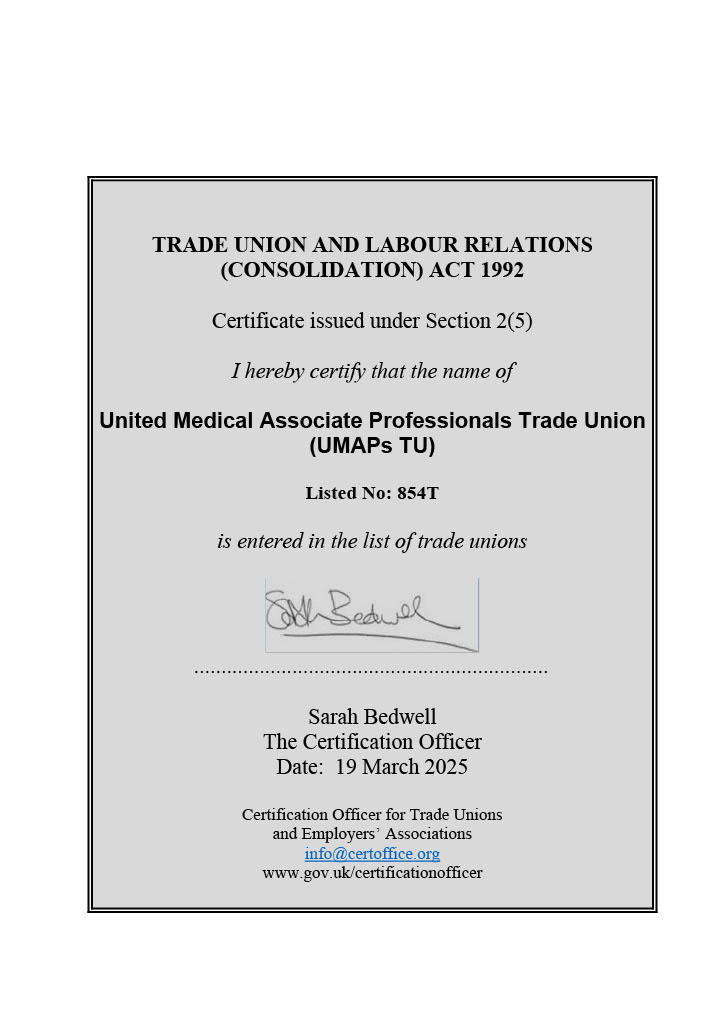
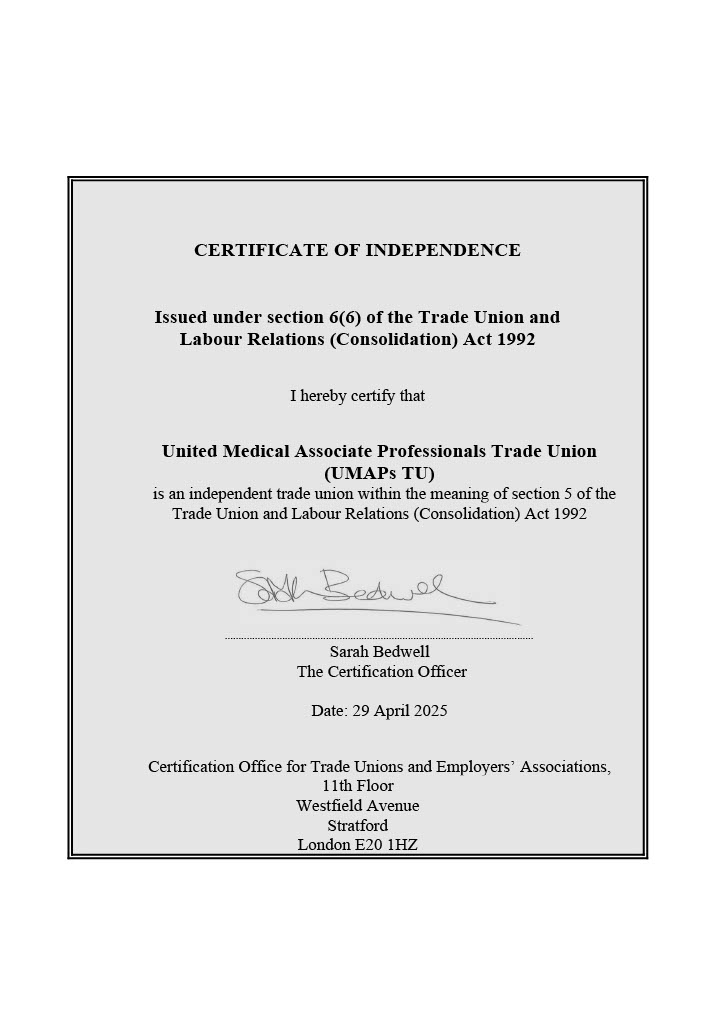
UMAPs was founded in November 2023, quickly reaching 300 members by March the following year. In December 2024, UMAPs held a meeting of founding members who voted to adopt the Trade Union Rulebook. As a result UMAPs TU was formed. By April 2025, UMAPs TU became one of the only trade unions to proceed straight from registering as a trade union to being certified as an independent trade union.
Today, UMAPs represents 60% of PAs working in the UK. The union is led by practising and former PAs and AAs who have a deep knowledge of these roles and direct experience of the challenges faced by the profession.
UMAPs membership is open to all PAs and AAs practising in the UK, as well as students preparing to enter the profession. We offer members training, advocacy, and legal support, as well as medical indemnity, and mental health and wellbeing services.
In July 2025, UMAPs launched its graduate network, connecting newly qualified MAPs with experienced associates and providing advice and support for entering the health service.
Since its establishment, UMAPs has represented and guided associates in nearly 800 employment disputes – with over 400 of those since the Leng Review. We are regularly consulted by national medical authorities, including the Royal Colleges and Care Quality Commission, as well as the House of Lords.
The Leng Review
In November 2024, previous Health Secretary Wes Streeting commissioned a review of the safety and effectiveness of PA and AA roles, led by Professor Gillian Leng. The review followed intense lobbying from the BMA, royal colleges, and doctors’ groups, who are opposed to the MAP professions. UMAPs was recognised as a major stakeholder and submitted a dossier of evidence about the PA role, including substantial evidence on safety and effectiveness from the US, where the PA role has existed for over sixty years. Very little of this evidence was cited in the final report.
On 16 July 2025 Professor Leng published her review. She found no compelling case that MAPs are unsafe or ineffective and acknowledged that much of the available evidence was tainted by
“bias” and the “toxic” debate that has grown around MAPs. Nevertheless, her recommendations fundamentally redefine MAPs’ core competencies and severely restrict their ability to effectively treat patients.
Among her recommendations, Professor Leng said PAs should be prevented from treating undifferentiated (i.e. undiagnosed patients). This completely removes the benefit of having such highly trained medical professionals on the frontline of the health service and ignores the fact that the PA role was specifically designed to support GP surgeries and emergency departments. This will result in potentially thousands of PAs being unfairly dismissed as they are no longer allowed to carry out the work they are trained to do. Since June 2024, there has already been an 11% decrease in the number of PAs working in primary care.
The Leng Review also recommended that PAs be renamed ‘Physician Assistants’. This is a spiteful suggestion that has nothing to do with patient safety or medical clarity and simply seeks to appease anti-MAP doctors. In April 2026, the DHSC launched a three-month consultation on this and other proposed changes to GMC legislation. UMAPs supports genuine, good-faith consultation, but based on the Leng Review process, in which our 66 submissions were ignored and all 18 recommendations were accepted by the Secretary of State on the day of publication. We now know that Professor Leng consulted on the recommendations with the Royal Colleges during the drafting of these positions. Organisations known to actively be adopting positions against the role. we have no confidence this consultation will be any different. Our position is unequivocal: the proposed rename is regressive, professionally damaging, and serves no patient safety purpose. It is a concession to a lobby group rather than a response to clinical evidence. We urge every physician associate, colleague, patient, and supporter to respond directly to the consultation before 24 June 2026 at:
https://www.gov.uk/government/consultations/reforming-the-general-medical-council-legislative-framework
The same day the original review was published, the government accepted its recommendations in full, without any time to assess the impact on MAPs, patients, or NHS waiting lists. Later that day, NHS England called for “immediate action” by employers to implement Professor Leng’s recommendations. The consequences have been severe. UMAPs’ Freedom of Information findings from 32 NHS Trusts, published in May 2026, revealed that the overwhelming majority made changes to PA roles in emergency departments without conducting any formal impact assessment beforehand. One trust found its PAs saw approximately 44% more patients over a comparable period than resident doctors, and concluded that full compliance with RCEM guidance “would decimate the rota.” Several trusts – including Guy’s and St Thomas’ – were ultimately forced to reverse or scale back those restrictions after finding they were directly harming patients and disrupting department flow.
Neither the government, nor NHSE, nor any of the royal colleges who supported the Leng Review’s recommendations made any assessment of how completely overhauling MAP roles will affect patient outcomes – despite the Review specifically praising the role of PAs in improving access to care. Intuitively this will result in severe harm to patients in a health service that is already struggling with under resourcing and a growing backlog of patients awaiting treatment.
In 2023, 125,720 deaths in England and Wales were considered avoidable with appropriate and timely treatment. Meanwhile, in 2023 the Darzi report found that long A&E wait times are likely to be causing an additional 14,000 more deaths each year.
This death toll will inevitably climb higher if thousands of highly trained medical professionals are left on the sidelines. This will likely result in a wave of individual and class action negligence claims by patients against NHS employers and chief medical officers who have failed to implement appropriate assessments and mitigations.
UMAPs has initiated judicial review proceedings against the government, NHS England, and Professor Leng to overturn the adoption of the Leng Review. Led by Patrick Green KC – previously of the sub-postmasters IT scandal – we will argue:
- Professor Leng was irrational to recommend such sweeping changes to MAP roles without any hard evidence that their work was unsafe.
- The government and/or NHSE failed to consult UMAPs as the recognised trade union for PAs and AAs before taking a decision that it knew would result in mass redundancies.
- The government has neglected its Tameside Duty to assess how these recommendations will affect the NHS and patients’ access to care.
- The government accepted the Leng recommendations to appease the increasingly radical BMA, which was threatening a strike by resident doctors at the time and has lobbied aggressively for MAPs’ scope of work to be reduced.
Timeline
-
UMAPs
-
Government/NHS
-
Legal
-
Key News/Publications
-
BMA
-
Royal Colleges
Guidance
Members
Write to your MP
Parliamentary pressure is one of the most effective tools available to us. Write to your constituency MP explaining the work you do, what your role means to patients, and how you’ve been personally affected by the Leng Review and the implementations of its recommendations. If you’re comfortable doing so, schedule a time to meet with your MP at one of their constituency surgeries. We’ve put together some guidance here:
My UMAPs > My Account > Write to MP
Respond to the GMC’s consultation on the name change
The DHSC has launched a three-month consultation on legislation that will overhaul the GMC regulation of doctors, PAs and AAs, including the implementation of Leng Review recommendations relating to renaming the professional titles of MAPs.
We urge our members to respond directly to this consultation. Responses must be submitted by 24 June 2026. Answer the survey questions clearly and in your own words. You can respond online via the official consultation page here:
Support the Legal Fund
Fighting a judicial review and running employment casework costs money. UMAPs is funded by its members, and if you are in a position to contribute beyond your membership, every donation directly funds the fight to protect your profession.
Spread the word of UMAPs’ campaign
Follow us on LinkedIn and make sure to repost and forward on our updates:
MAPs – non-UMAPs members
Join UMAPs!
UMAPs is the only organisation fighting in the courts, in Parliament, and in the press for MAPs, and it is doing so on behalf of its members. If your scope of practice has been restricted, if your employer has presented you with contract changes, or if you are uncertain about your rights or your future in this profession, you need a trade union to be in your corner and help fight your case. UMAPs has represented and guided associates in over 400 employment disputes since the Leng Review, and is undertaking a judicial review that will determine the future of the profession. Join today:
Write to your MP
Respond to the GMC’s consultation on the name change
The DHSC has launched a three-month consultation on legislation that will overhaul the GMC regulation of doctors, PAs and AAs, including the implementation of Leng Review recommendations relating to renaming the professional titles of MAPs.
We urge all associates to respond directly to this consultation. Responses must be submitted by 24 June 2026. Answer the survey questions clearly and in your own words. You can respond online via the official consultation page at:
Employers
Respond to the GMC’s consultation on the name change
We urge our all employers of associates to respond directly to this consultation. Responses must be submitted by 24 June 2026. Answer the survey questions clearly and in your own words. You can respond online via the official consultation page at:
Await outcome of judicial review before changing associate scope of work
With our judicial review ongoing, UMAPs strongly advises all employers to hold off on making any material changes to associates’ scope of work until the outcome is known. Employers who proceed regardless should be aware that they may be required to defend their decisions through legal proceedings.
Colleagues (wider MDT)
Respond to the GMC’s consultation on the name change
You work alongside associates every day. Your perspective on how the role functions within multidisciplinary teams, and what a change of title could mean in practice, is exactly what this consultation needs to hear. Responses must be submitted by 24 June 2026. Answer the survey questions clearly and in your own words. You can respond online via the official consultation page at:

